 Reviews

Labradorite: Mineral & Crystal Guide
There are minerals that impress you with geometry—sharp prisms, perfect cubes, the kind of crystals that look engineered. And then there are minerals that perform. Labradorite is in that second category: a usually gray-to-charcoal plagioclase feldspar that, at just the right angle, ignites from within—electric blues, molten golds, sea-greens, occasional tangerine and copper—like someone hid a thin sheet of aurora borealis under the surface and forgot to mention it. That inner flash has a proper scientific name (labradorescence), but it also has a stage presence that makes even non-collectors stop mid-sentence.
One of the most interesting things about labradorite is that it’s not “rare” in the way emerald is rare. Geologically, it’s common enough to be a serious rock-former—especially in mafic igneous rocks such as basalt and gabbro, and famously in anorthosite bodies that can be made largely of plagioclase feldspar. Yet gemmy, high-flash labradorite is another story: the raw material may be widespread, but the exact internal structure that produces strong, clean labradorescence is picky about composition and cooling history. Mindat describes labradorite as an intermediate member of the albite–anorthite plagioclase series (roughly in the range where the albite:anorthite ratio sits around 30:70 to 50:50). That compositional “sweet spot” matters because it’s tied to the microscopic layering that turns ordinary feldspar into a natural diffraction grating.
Its origin story is equally dramatic. Labradorite is named for the Labrador region of Canada, with the type area cited near Paul’s Island by Nain, where it was documented in the late 18th century. The stone’s name bakes in its birthplace: rugged coastline, hard light, cold water—exactly the sort of landscape you’d expect to produce a mineral that looks like storm clouds hiding neon. Over time, labradorite became a favorite for cabochons and polished slabs because the effect is directional: you don’t “see” labradorite so much as you unlock it by cutting to the right plane. Encyclopaedia Britannica notes that when used as a gem it’s commonly cut en cabochon, a shape that helps maximize the reflected iridescence.
Another fun twist: the color is not pigment. Labradorite isn’t “blue” the way lapis is blue. The base material can be gray, brown, nearly black—and still flash bright color because the color comes from physics, not chemistry in the usual sense. In other words, labradorite is a reminder that nature doesn’t need dye to be vivid; sometimes it just needs the right nanoscale architecture.
And that’s why labradorite has become one of the most beloved “gateway minerals” for collectors: it sits at a perfect intersection of everyday geology and jaw-dropping optics. It’s a common mineral that can look supernatural; a rock-former that moonlights as a gemstone; an object lesson in how slow cooling and subtle compositional changes can create beauty you can hold in your hand.
Mineral group: Feldspar group, plagioclase series
Crystal system: Triclinic
Hardness (Mohs): ~6–6.5
Luster: Vitreous; may be pearly on cleavage surfaces
Cleavage: Feldspar-typical, strong cleavage surfaces
Streak: White
Specific gravity: commonly around 2.68–2.72
Optical “special effect”: Labradorescence (iridescent schiller/play-of-color)
Typical appearance: gray/brown/black body color; flashes of blue, green and gold
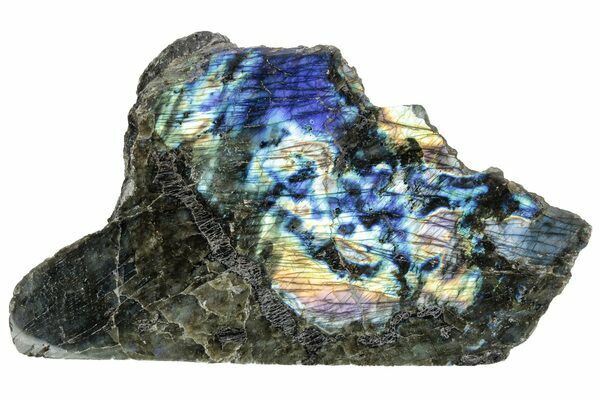
A brilliant piece of labradorite from Ampanihy, Madagascar.
Labradorescence is the colorful glow you see inside labradorite. It happens because of extremely thin layers that form inside the crystal as it cools. When labradorite first forms deep underground, it starts out as a more uniform crystal at very high temperatures. As it slowly cools, its internal structure becomes unstable. The mineral then separates into many ultra-thin layers with slightly different compositions. These layers are incredibly small — about the same thickness as wavelengths of visible light.
When light enters the stone, it hits these tiny layers and bounces around between them. The layers scatter and reflect the light in a special way, creating the bright flashes of blue, green, gold, and other colors that seem to glow from inside the stone. This is why two pieces of labradorite from the same area can look very different. If the internal layers are poorly formed, uneven, or spaced incorrectly, the stone may look dull — just like ordinary feldspar. But if the layers are well formed and spaced just right, the stone can produce strong, vivid flashes that almost look metallic.
Cutting also plays an important role. Labradorescence is directional, meaning the color only appears at certain angles. Skilled cutters shape and orient the stone so the strongest “sheet” of color is positioned on top, allowing it to reflect the maximum amount of light back to the viewer.
Labradorite is a plagioclase feldspar, meaning it forms in a wide range of igneous settings where feldspars crystallize from magma. It is especially associated with mafic igneous rocks (like basalt and gabbro) and with anorthosite bodies (plagioclase-rich intrusions that can be spectacularly massive). In a cooling magma chamber, plagioclase crystals grow as part of the rock’s primary fabric—often as lath-shaped grains in basalts or larger crystals in slow-cooled intrusive rocks.
The key to “gemmy” labradorite is not just forming plagioclase, but forming it under conditions that later allow the exsolution lamellae responsible for labradorescence to develop. That generally points to slow cooling at depth (or at least a cooling history that lingers long enough in the right temperature range for the internal layering to organize). So, while labradorite as a mineral can be common, labradorite as a dramatic optical gem is, in a sense, a record of a very particular thermal story written at the nanoscale.
Spectrolite is an uncommon variety of labradorite prized for showing a broader, richer range of colors than typical material—often including strong greens, yellows, blues, and warmer coppery to red tones in the same stone. In modern usage it’s closely associated with Finland, especially the Ylämaa area, where it became famous enough to function as both a gem variety and a locality-based brand name.
Geologically, spectrolite isn’t a different mineral species—it’s still labradorite feldspar. What changes is the quality and distribution of the internal lamellar structures and how they interact with light, producing that “all the colors” impression. Finland’s gem institutions and commercial sources emphasize its exceptional color range and its identity as Finnish material from Ylämaa.
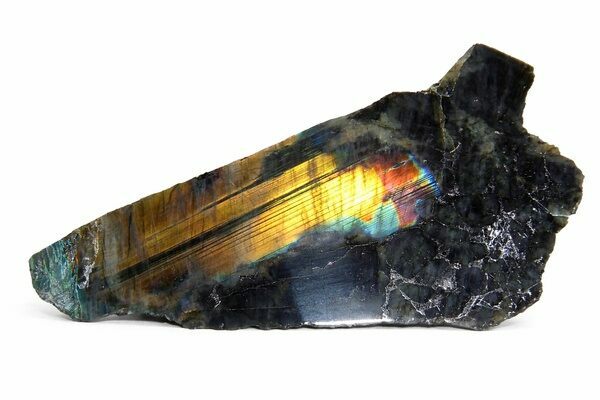
A piece of spectrolite from Finland showing a wider range of color than seen in most Labradorite.
Collectors’ note: in casual gem trade, “spectrolite” sometimes gets used loosely for any labradorite with unusually strong multi-color flash. But the strictest use ties it to the Finnish occurrence.
The story of labradorite begins in a rugged, wind-swept landscape where land, sea, and sky blur together in the cold light of the far north. Along the coast of Labrador, Canada, early European explorers and missionaries encountered an unusual stone unlike anything they had seen before. At first glance, it appeared plain—gray, dark, almost ordinary. But when turned in the hand, it suddenly ignited with shimmering color: electric blues, glowing greens, flashes of gold, like sunlight breaking through storm clouds.
This remarkable effect captured attention immediately, and the mineral was eventually named labradorite after the region where it was first formally described in the late 18th century. The stone became linked forever with its birthplace, a place already rich in mystery and harsh beauty. Labradorite’s identity was shaped not just by science, but by awe. It was a mineral that seemed to hold light inside itself, as though it had trapped the northern sky beneath its surface.
As mineralogy developed as a formal science, labradorite found its place within the feldspar family, recognized as an important member of the plagioclase series. Unlike rare gemstones that occur only in small pockets of the Earth, labradorite was revealed to be something more widespread—a mineral that helps build the very crust of the planet. It forms in igneous rocks like basalt and gabbro, meaning that while gem-quality labradorite may feel magical, its roots are deeply geological and foundational. It is, in many ways, a stone that bridges the ordinary and the extraordinary: common in composition, uncommon in beauty.
Through the centuries, labradorite became treasured not only by scientists and collectors, but also by artisans. Its flashes of color—known as labradorescence—made it a natural choice for decorative use. By the 19th and 20th centuries, polished labradorite began appearing in jewelry, carvings, and ornamental stonework. Cutters learned that the stone’s color was not random, but directional, and that careful shaping could unlock sheets of brilliant light. Labradorite was most often cut into smooth cabochons, allowing the surface to act like a window into the stone’s inner fire.
In the modern gemstone world, labradorite holds a unique position. It is not prized for clarity like a diamond or for deep color like a ruby. Instead, it is valued for movement—for the way it changes with every tilt of the hand. A piece of labradorite is never static. It performs. Its beauty is dynamic, alive, almost theatrical, and that makes it endlessly appealing to jewelers who want stones that feel mysterious and cosmic.
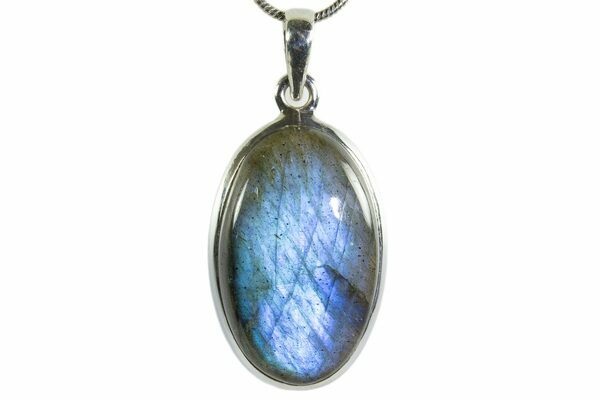
A brilliant blue labradorite pendant.
Beyond jewelry, labradorite has also become popular as an architectural and decorative material. Large slabs of labradorite-rich rock are polished for countertops, tiles, and statement pieces. In interior lighting, these surfaces can shimmer dramatically, transforming ordinary stone into something that feels otherworldly. In this way, labradorite has moved from remote northern shores into homes, galleries, and modern design spaces around the world.
Although labradorite is a common rock-forming mineral found in many parts of the world, not all deposits produce material with strong, vibrant labradorescence. The quality, intensity, and range of color depend on very specific geological conditions, particularly the mineral’s composition and cooling history. As a result, a handful of localities have become especially well known among collectors and lapidaries for producing exceptional specimens.
Madagascar has become one of the best-known modern sources of high-impact labradorite, especially for large polished pieces and carvings. Mindat explicitly lists the Ampanihy District among notable localities, reflecting how prominent the material has become in the marketplace and among collectors. Madagascar labradorite often appears in bigger formats—hearts, palm stones, slabs—because deposits can yield sizable blocks suitable for carving and décor. Collectors often look for broad “sheet” flashes with minimal internal breakage, as large pieces make any weakness more obvious.
Labrador is the mineral’s namesake and classic collecting reference point. Mineral listings and handbooks cite Paul’s Island near Nain as the type area, anchoring labradorite’s identity to Canada’s Labrador coast. Material from this broader region is often described as producing strong blue-to-gold flashes, and historically it helped establish the public idea of “labradorite” as a dark stone with a hidden light show. For collectors, Canadian material carries an extra satisfaction: it connects directly to the mineral’s naming story, like holding a first edition.
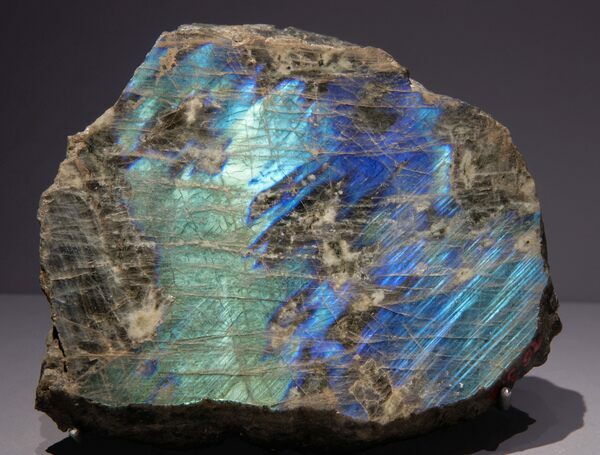
A Labradorite specimen from Labrador, Canada. Collection of the Gallery of Mineralogy and Geology, French National Museum of Natural History, Paris.
If “labradorite” is the general phenomenon, Ylämaa is one of the places where that phenomenon reaches peak theatricality. Mindat lists the Ylämaa spectrolite quarries as a notable labradorite locality, and Finnish gem sources emphasize spectrolite’s exceptional range of colors and its identity as a Finnish specialty. For collectors, spectrolite is often about variety within one stone: multiple hues, shifting angles, and that rarer warmth (copper/red) that many standard labradorites show only faintly. It’s also a locality where “provenance” matters—many collectors value Finnish material precisely because the name spectrolite is so tied to place.

One of the most interesting things about labradorite is that it’s not “rare” in the way emerald is rare. Geologically, it’s common enough to be a serious rock-former—especially in mafic igneous rocks such as basalt and gabbro, and famously in anorthosite bodies that can be made largely of plagioclase feldspar. Yet gemmy, high-flash labradorite is another story: the raw material may be widespread, but the exact internal structure that produces strong, clean labradorescence is picky about composition and cooling history. Mindat describes labradorite as an intermediate member of the albite–anorthite plagioclase series (roughly in the range where the albite:anorthite ratio sits around 30:70 to 50:50). That compositional “sweet spot” matters because it’s tied to the microscopic layering that turns ordinary feldspar into a natural diffraction grating.
Its origin story is equally dramatic. Labradorite is named for the Labrador region of Canada, with the type area cited near Paul’s Island by Nain, where it was documented in the late 18th century. The stone’s name bakes in its birthplace: rugged coastline, hard light, cold water—exactly the sort of landscape you’d expect to produce a mineral that looks like storm clouds hiding neon. Over time, labradorite became a favorite for cabochons and polished slabs because the effect is directional: you don’t “see” labradorite so much as you unlock it by cutting to the right plane. Encyclopaedia Britannica notes that when used as a gem it’s commonly cut en cabochon, a shape that helps maximize the reflected iridescence.
Another fun twist: the color is not pigment. Labradorite isn’t “blue” the way lapis is blue. The base material can be gray, brown, nearly black—and still flash bright color because the color comes from physics, not chemistry in the usual sense. In other words, labradorite is a reminder that nature doesn’t need dye to be vivid; sometimes it just needs the right nanoscale architecture.
And that’s why labradorite has become one of the most beloved “gateway minerals” for collectors: it sits at a perfect intersection of everyday geology and jaw-dropping optics. It’s a common mineral that can look supernatural; a rock-former that moonlights as a gemstone; an object lesson in how slow cooling and subtle compositional changes can create beauty you can hold in your hand.
Labradorite Properties
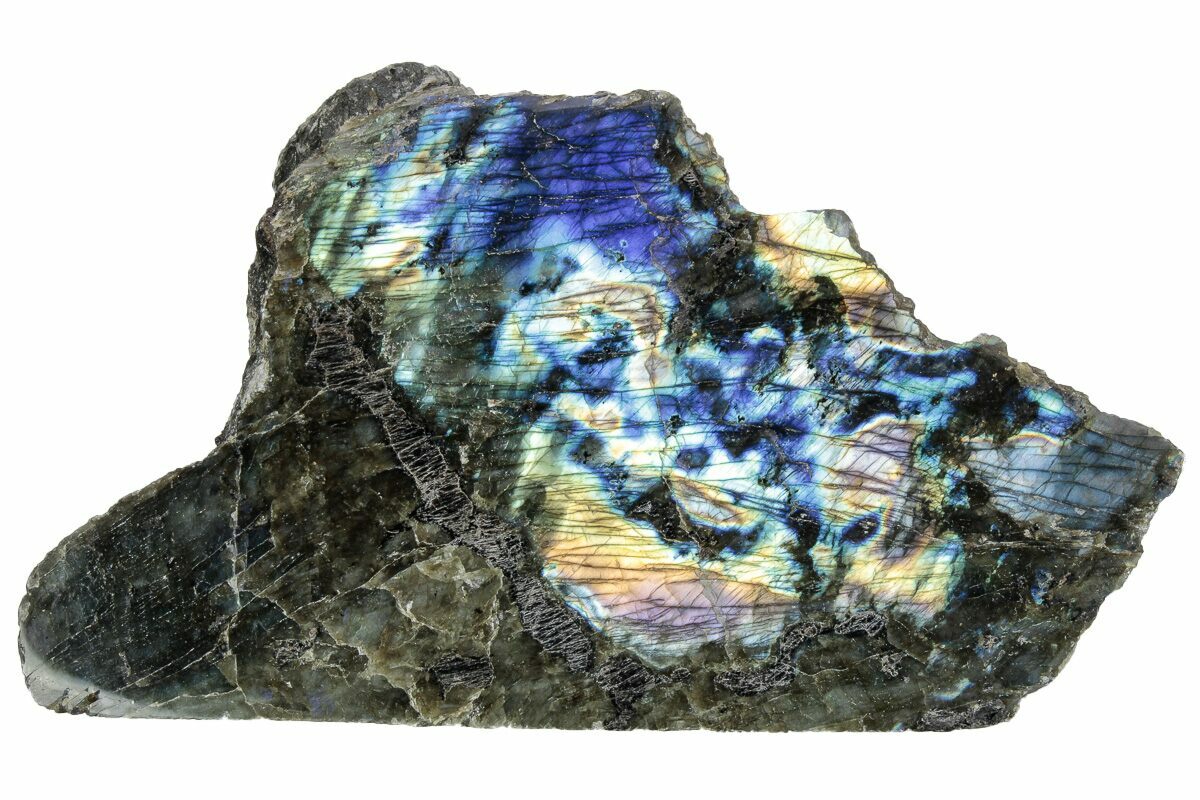
A brilliant piece of labradorite from Ampanihy, Madagascar.
What Causes Labradorescence?
Labradorescence is the colorful glow you see inside labradorite. It happens because of extremely thin layers that form inside the crystal as it cools. When labradorite first forms deep underground, it starts out as a more uniform crystal at very high temperatures. As it slowly cools, its internal structure becomes unstable. The mineral then separates into many ultra-thin layers with slightly different compositions. These layers are incredibly small — about the same thickness as wavelengths of visible light.
When light enters the stone, it hits these tiny layers and bounces around between them. The layers scatter and reflect the light in a special way, creating the bright flashes of blue, green, gold, and other colors that seem to glow from inside the stone. This is why two pieces of labradorite from the same area can look very different. If the internal layers are poorly formed, uneven, or spaced incorrectly, the stone may look dull — just like ordinary feldspar. But if the layers are well formed and spaced just right, the stone can produce strong, vivid flashes that almost look metallic.
Cutting also plays an important role. Labradorescence is directional, meaning the color only appears at certain angles. Skilled cutters shape and orient the stone so the strongest “sheet” of color is positioned on top, allowing it to reflect the maximum amount of light back to the viewer.
How Labradorite Forms
Labradorite is a plagioclase feldspar, meaning it forms in a wide range of igneous settings where feldspars crystallize from magma. It is especially associated with mafic igneous rocks (like basalt and gabbro) and with anorthosite bodies (plagioclase-rich intrusions that can be spectacularly massive). In a cooling magma chamber, plagioclase crystals grow as part of the rock’s primary fabric—often as lath-shaped grains in basalts or larger crystals in slow-cooled intrusive rocks.
The key to “gemmy” labradorite is not just forming plagioclase, but forming it under conditions that later allow the exsolution lamellae responsible for labradorescence to develop. That generally points to slow cooling at depth (or at least a cooling history that lingers long enough in the right temperature range for the internal layering to organize). So, while labradorite as a mineral can be common, labradorite as a dramatic optical gem is, in a sense, a record of a very particular thermal story written at the nanoscale.
Spectrolite: The “Full-Spectrum” Celebrity
Spectrolite is an uncommon variety of labradorite prized for showing a broader, richer range of colors than typical material—often including strong greens, yellows, blues, and warmer coppery to red tones in the same stone. In modern usage it’s closely associated with Finland, especially the Ylämaa area, where it became famous enough to function as both a gem variety and a locality-based brand name.
Geologically, spectrolite isn’t a different mineral species—it’s still labradorite feldspar. What changes is the quality and distribution of the internal lamellar structures and how they interact with light, producing that “all the colors” impression. Finland’s gem institutions and commercial sources emphasize its exceptional color range and its identity as Finnish material from Ylämaa.
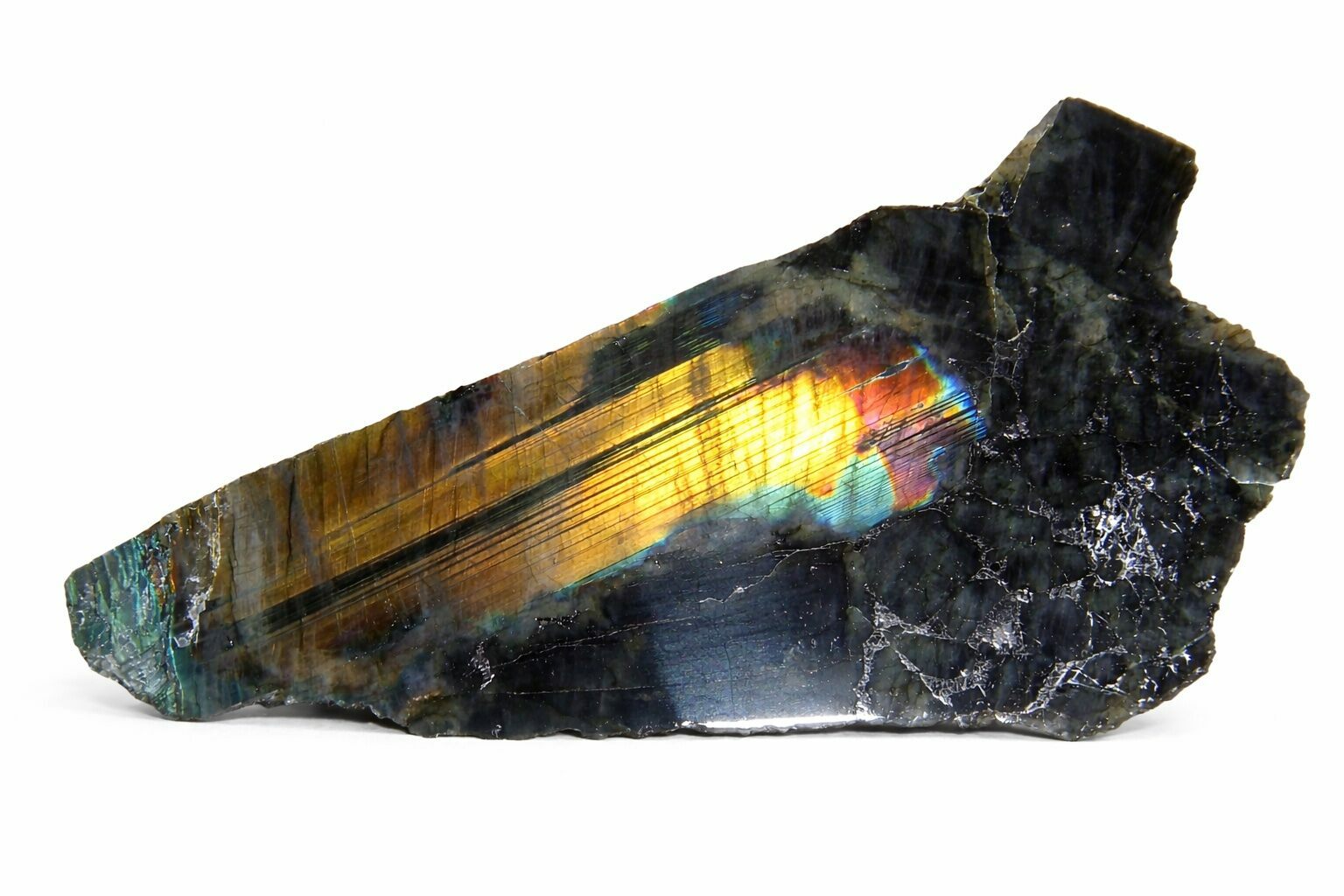
A piece of spectrolite from Finland showing a wider range of color than seen in most Labradorite.
Collectors’ note: in casual gem trade, “spectrolite” sometimes gets used loosely for any labradorite with unusually strong multi-color flash. But the strictest use ties it to the Finnish occurrence.
History and Uses of Labradorite
The story of labradorite begins in a rugged, wind-swept landscape where land, sea, and sky blur together in the cold light of the far north. Along the coast of Labrador, Canada, early European explorers and missionaries encountered an unusual stone unlike anything they had seen before. At first glance, it appeared plain—gray, dark, almost ordinary. But when turned in the hand, it suddenly ignited with shimmering color: electric blues, glowing greens, flashes of gold, like sunlight breaking through storm clouds.
This remarkable effect captured attention immediately, and the mineral was eventually named labradorite after the region where it was first formally described in the late 18th century. The stone became linked forever with its birthplace, a place already rich in mystery and harsh beauty. Labradorite’s identity was shaped not just by science, but by awe. It was a mineral that seemed to hold light inside itself, as though it had trapped the northern sky beneath its surface.
As mineralogy developed as a formal science, labradorite found its place within the feldspar family, recognized as an important member of the plagioclase series. Unlike rare gemstones that occur only in small pockets of the Earth, labradorite was revealed to be something more widespread—a mineral that helps build the very crust of the planet. It forms in igneous rocks like basalt and gabbro, meaning that while gem-quality labradorite may feel magical, its roots are deeply geological and foundational. It is, in many ways, a stone that bridges the ordinary and the extraordinary: common in composition, uncommon in beauty.
Through the centuries, labradorite became treasured not only by scientists and collectors, but also by artisans. Its flashes of color—known as labradorescence—made it a natural choice for decorative use. By the 19th and 20th centuries, polished labradorite began appearing in jewelry, carvings, and ornamental stonework. Cutters learned that the stone’s color was not random, but directional, and that careful shaping could unlock sheets of brilliant light. Labradorite was most often cut into smooth cabochons, allowing the surface to act like a window into the stone’s inner fire.
In the modern gemstone world, labradorite holds a unique position. It is not prized for clarity like a diamond or for deep color like a ruby. Instead, it is valued for movement—for the way it changes with every tilt of the hand. A piece of labradorite is never static. It performs. Its beauty is dynamic, alive, almost theatrical, and that makes it endlessly appealing to jewelers who want stones that feel mysterious and cosmic.
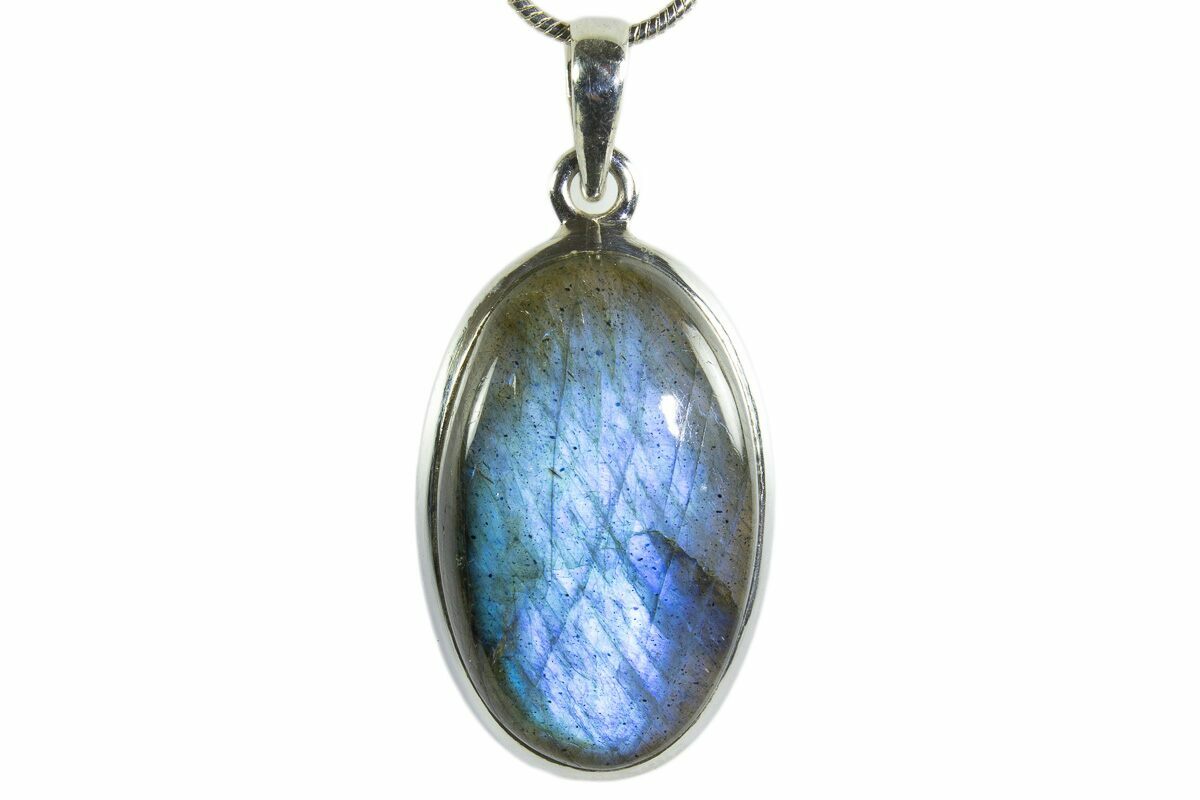
A brilliant blue labradorite pendant.
Beyond jewelry, labradorite has also become popular as an architectural and decorative material. Large slabs of labradorite-rich rock are polished for countertops, tiles, and statement pieces. In interior lighting, these surfaces can shimmer dramatically, transforming ordinary stone into something that feels otherworldly. In this way, labradorite has moved from remote northern shores into homes, galleries, and modern design spaces around the world.
Key Collecting Localities
Although labradorite is a common rock-forming mineral found in many parts of the world, not all deposits produce material with strong, vibrant labradorescence. The quality, intensity, and range of color depend on very specific geological conditions, particularly the mineral’s composition and cooling history. As a result, a handful of localities have become especially well known among collectors and lapidaries for producing exceptional specimens.
Madagascar (notably the Ampanihy District, Atsimo-Andrefana)
Madagascar has become one of the best-known modern sources of high-impact labradorite, especially for large polished pieces and carvings. Mindat explicitly lists the Ampanihy District among notable localities, reflecting how prominent the material has become in the marketplace and among collectors. Madagascar labradorite often appears in bigger formats—hearts, palm stones, slabs—because deposits can yield sizable blocks suitable for carving and décor. Collectors often look for broad “sheet” flashes with minimal internal breakage, as large pieces make any weakness more obvious.
Labrador, Canada (Nain / Paul’s Island area)
Labrador is the mineral’s namesake and classic collecting reference point. Mineral listings and handbooks cite Paul’s Island near Nain as the type area, anchoring labradorite’s identity to Canada’s Labrador coast. Material from this broader region is often described as producing strong blue-to-gold flashes, and historically it helped establish the public idea of “labradorite” as a dark stone with a hidden light show. For collectors, Canadian material carries an extra satisfaction: it connects directly to the mineral’s naming story, like holding a first edition.
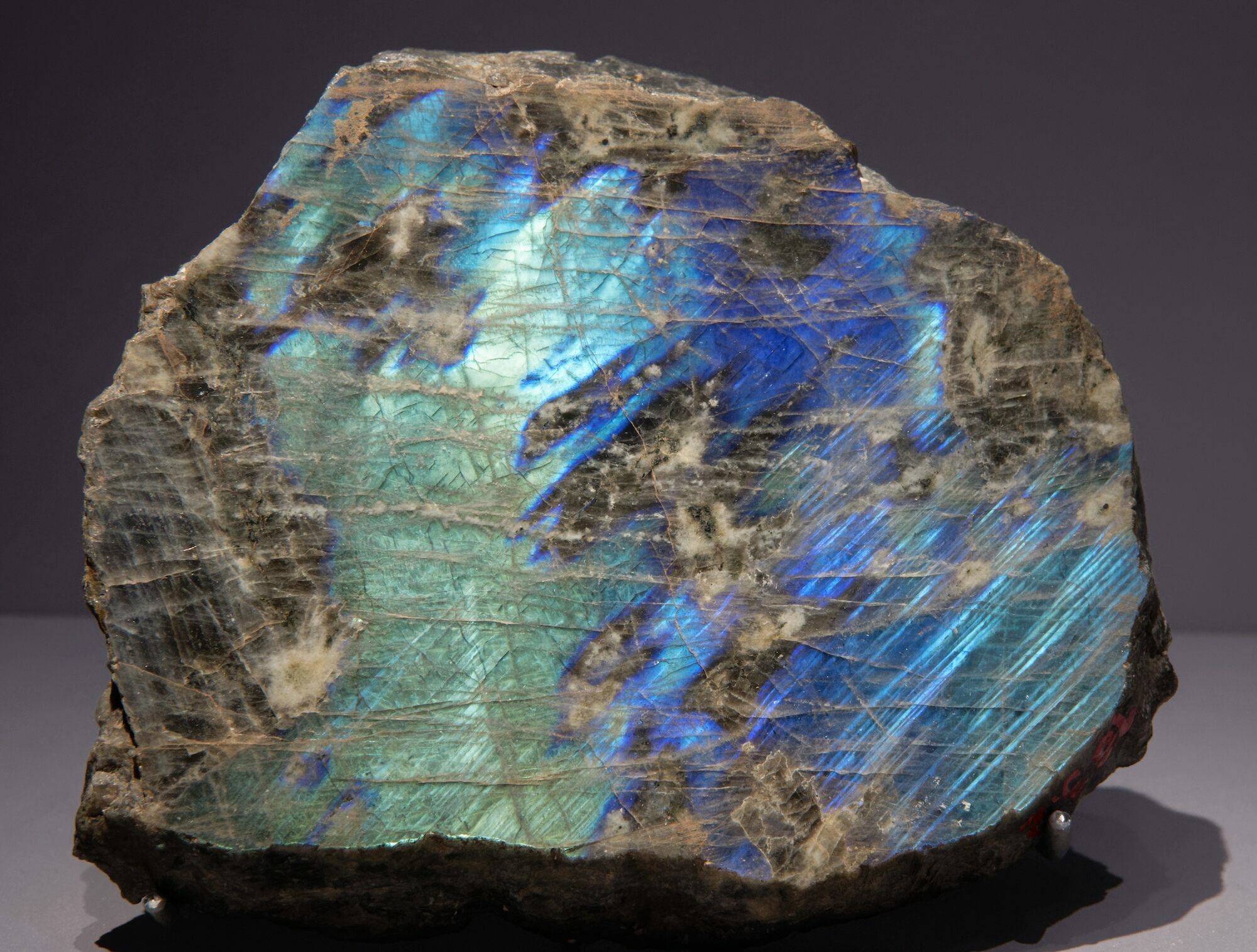
A Labradorite specimen from Labrador, Canada. Collection of the Gallery of Mineralogy and Geology, French National Museum of Natural History, Paris.
Ylämaa, Finland (Spectrolite quarries)
If “labradorite” is the general phenomenon, Ylämaa is one of the places where that phenomenon reaches peak theatricality. Mindat lists the Ylämaa spectrolite quarries as a notable labradorite locality, and Finnish gem sources emphasize spectrolite’s exceptional range of colors and its identity as a Finnish specialty. For collectors, spectrolite is often about variety within one stone: multiple hues, shifting angles, and that rarer warmth (copper/red) that many standard labradorites show only faintly. It’s also a locality where “provenance” matters—many collectors value Finnish material precisely because the name spectrolite is so tied to place.


