 Reviews

Titanite — The Crystal With Unforgettable Fire
If minerals had reputations like rock stars, titanite would be the headliner. In the gemstone world it’s better known as sphene, a name still used when the mineral is faceted into gems. Titanite is famous for its explosive, rainbow-filled sparkle, splitting light into flashes of color even more intense than diamond’s fire. It’s a mineral that seems to crackle when it catches the sun, throwing bursts of spectral brilliance that look almost supernatural. While it’s softer than diamond, it more than compensates with sheer visual drama. Many crystals form in sharp wedge or envelope-like shapes, so cleanly defined that they can look more like tiny relics of a lost technology than something grown inside the Earth.
Beyond its sparkle, titanite has a collection of quirks that make it even more compelling. Some crystals display a warm, amber shine, while others glow green or orange under UV light like smoldering coals. Certain specimens can contain minute traces of elements that make them very mildly radioactive, though completely safe to handle and display—just enough to make them detectable to sensitive instruments, and to deepen their mystique. When you consider that these gems also bend and split light in unusual ways, sometimes appearing to show doubled internal reflections, titanite becomes a mineral that isn’t just beautiful, but interactive—one that rewards anyone who studies it from different angles or lighting.
And then there’s the deeper story: titanite is one of the best natural record-keepers of Earth’s most intense chapters. When heated far below the surface during mountain building or crustal changes, it can “rewrite” parts of its internal history, allowing geologists to trace not just when a rock formed, but the major events it lived through—the rise of mountains, the pulse of underground heat, and the long cooling that followed. Some titanite crystals even preserve older inner sections with younger outer layers, like a planet’s autobiography preserved in growth rings. It’s this dual identity—a natural light show and a mineral historian—that makes titanite one of the most fascinating specimens on Earth, especially for collectors who love beauty with a story.
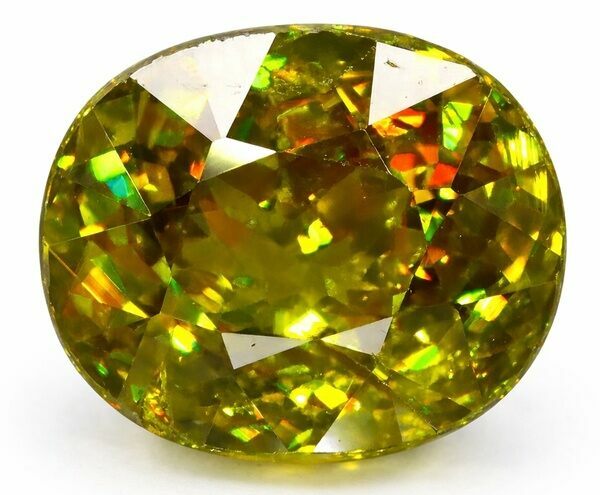
A faceted titanite (Sphene) gemstone.
Physical and Optical Properties
Chemical Formula: CaTiSiO₅
Mineral Class: Nesosilicate
Crystal System: Monoclinic
Typical Crystal Habit: Wedge-shaped, tabular, envelope-like, sometimes spear-like
Hardness: 5 – 5.5 (Mohs) — softer than most popular gems
Luster: Vitreous to resinous to adamantine
Refractive Index: Very high (1.843–2.110)
Birefringence: Strong (0.100–0.135) — causes doubling of facets in gems
Dispersion: 0.051 (higher than diamond’s 0.044)
Specific Gravity: 3.3 – 3.6
Cleavage: Imperfect, may fracture when cut
Streak: White
Titanite’s extreme refractive index and birefringence make gems appear as though internal facets are doubled or blurred in motion—an effect not seen in diamond, sapphire, or even zircon. Under magnification, sphene gems often show distinct doubling of pavilion facets, a feature gemologists use to identify the stone instantly. Its luster can vary dramatically depending on iron content, with darker crystals tending toward a resinous glow, while titanium-rich alpine cleft crystals can reach near-adamantine brilliance.
Color Origins and Varieties
Titanite occurs in a range of colors, most commonly:
Green to yellow-green: Often from iron (Fe²⁺/Fe³⁺) substitution
Honey-yellow to golden: Lower iron content; common gem material
Brown to reddish-brown: High iron content
Black: Very iron-rich; opaque, non-gem quality
Rare pink, orange, or color-shift stones: From trace element variations
A particularly exotic trait of titanite is pleochroism—crystals can show different colors when rotated in polarized light, sometimes shifting from green to yellow to brown depending on orientation. Some gem titanite also shows color-change behavior under different lighting (daylight vs. incandescent), especially stones with complex Fe + REE chemistry.
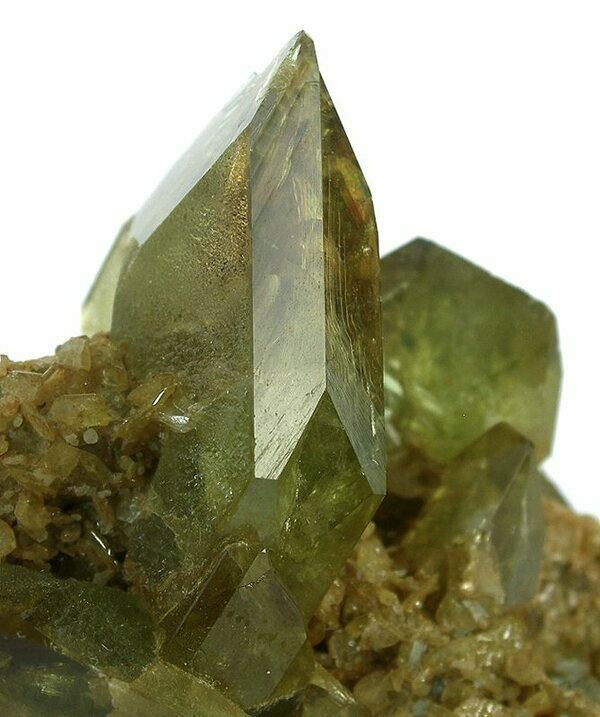
A rough, wedge-shaped Titanite (Sphene) Crystals From Brazil.
Titanite crystallizes in several major geological settings:
1. Metamorphic Rocks
Titanite is abundant in gneiss, schist, marble, amphibolite, and granulite facies rocks. During regional metamorphism, calcium from carbonate or feldspar combines with titanium mobilized from precursor minerals (like ilmenite or rutile) and silica from quartz or feldspar to form titanite. In high-grade metamorphic terrains, titanite is an important index mineral for pressure-temperature (P-T) path reconstruction.
2. Alkaline Igneous Rocks
Titanite thrives in alkaline and silica-undersaturated igneous systems, including syenite, nepheline syenite, phonolite, carbonatite, and pegmatites. It is particularly common in carbonatite complexes, where calcium is abundant and titanium is concentrated in late-stage fluids.
3. Skarns and Contact Metamorphic Zones
In skarn deposits (formed when magma intrudes limestone), titanite grows alongside garnet, diopside, vesuvianite, apatite, and magnetite. These crystals can be exceptionally large and sharply formed.
4. Alpine Clefts and Hydrothermal Veins
Some of the world’s most aesthetic titanite specimens come from Alpine-type clefts in the European Alps (especially Switzerland and Austria). These crystals are often transparent, lustrous, and dramatic in shape, perched on matrix minerals like chlorite, adularia, albite, or calcite.
Titanite is a workhorse mineral in U-Pb geochronology. It incorporates uranium into its crystal lattice while rejecting lead during formation. Over time, uranium decays to lead at a known rate, allowing precise age determination. Unlike zircon, which is so robust it often preserves its original age even after multiple heating events, titanite is more thermally sensitive and can reset during metamorphism at ~600–700 °C. This makes titanite uniquely powerful for answering questions like:
When did this mountain belt cool through 650 °C?
How many metamorphic heating pulses did this crust experience?
Did this rock melt, or just heat and recrystallize?
Because it recrystallizes more easily, titanite can record multiple generations within the same rock, sometimes preserving older cores with younger rims—similar to tree rings, but written in isotopes. Titanite is also used in thermochronology to track cooling histories, and in trace-element analysis to infer the chemistry of ancient hydrothermal fluids.
Some famous titanite-producing regions include:
Switzerland (Alps): Classic alpine cleft crystals, museum-quality
Austria (Zillertal, Tyrol): Transparent, sharp, high-luster crystals
Pakistan (Shigar Valley, Skardu): Large green-gold crystals, gem-grade
Madagascar: Yellow-green gem material
Canada (Ontario): Occurs in metamorphic and alkaline igneous rocks
Russia (Kola Peninsula): Titanite in alkaline complexes
Mexico: Found in skarns
In the gem world, faceted sphene is treasured for its diamond-beating fire, but its softness and imperfect cleavage make cutting risky. Stones can chip during faceting, polishing requires finesse, and gems demand protective settings in jewelry. For mineral collectors, however, titanite hits a sweet spot: high brilliance + complex crystal forms + strong locality appeal, with specimens that display beautifully even when untouched by gem cutting.

Beyond its sparkle, titanite has a collection of quirks that make it even more compelling. Some crystals display a warm, amber shine, while others glow green or orange under UV light like smoldering coals. Certain specimens can contain minute traces of elements that make them very mildly radioactive, though completely safe to handle and display—just enough to make them detectable to sensitive instruments, and to deepen their mystique. When you consider that these gems also bend and split light in unusual ways, sometimes appearing to show doubled internal reflections, titanite becomes a mineral that isn’t just beautiful, but interactive—one that rewards anyone who studies it from different angles or lighting.
And then there’s the deeper story: titanite is one of the best natural record-keepers of Earth’s most intense chapters. When heated far below the surface during mountain building or crustal changes, it can “rewrite” parts of its internal history, allowing geologists to trace not just when a rock formed, but the major events it lived through—the rise of mountains, the pulse of underground heat, and the long cooling that followed. Some titanite crystals even preserve older inner sections with younger outer layers, like a planet’s autobiography preserved in growth rings. It’s this dual identity—a natural light show and a mineral historian—that makes titanite one of the most fascinating specimens on Earth, especially for collectors who love beauty with a story.
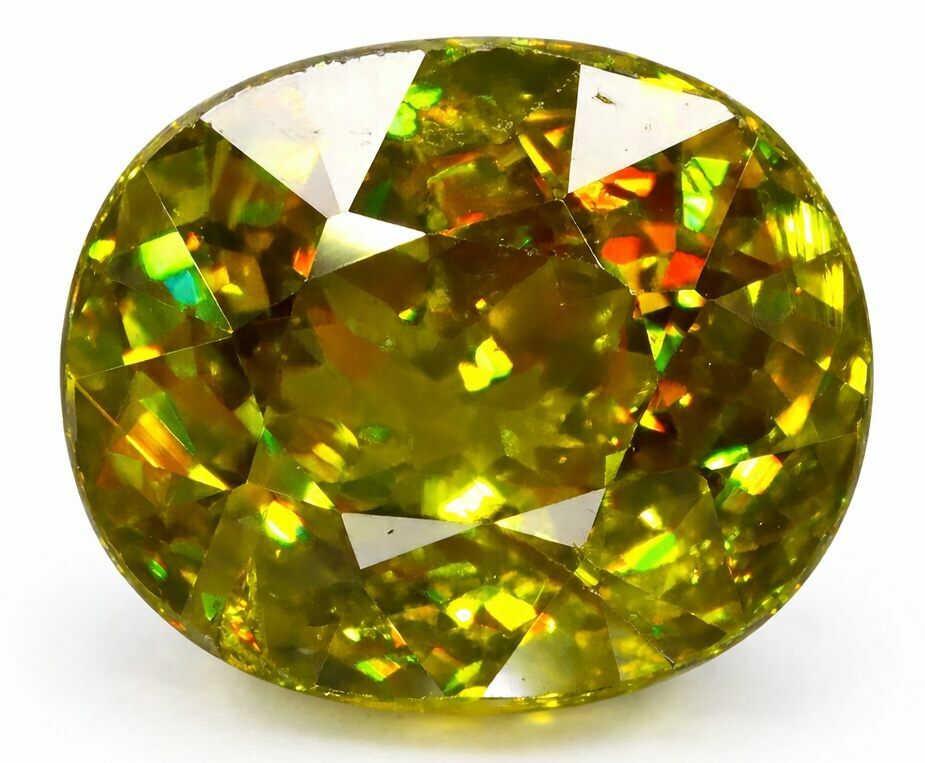
A faceted titanite (Sphene) gemstone.
Physical and Optical Properties
Chemical Formula: CaTiSiO₅
Mineral Class: Nesosilicate
Crystal System: Monoclinic
Typical Crystal Habit: Wedge-shaped, tabular, envelope-like, sometimes spear-like
Hardness: 5 – 5.5 (Mohs) — softer than most popular gems
Luster: Vitreous to resinous to adamantine
Refractive Index: Very high (1.843–2.110)
Birefringence: Strong (0.100–0.135) — causes doubling of facets in gems
Dispersion: 0.051 (higher than diamond’s 0.044)
Specific Gravity: 3.3 – 3.6
Cleavage: Imperfect, may fracture when cut
Streak: White
Titanite’s extreme refractive index and birefringence make gems appear as though internal facets are doubled or blurred in motion—an effect not seen in diamond, sapphire, or even zircon. Under magnification, sphene gems often show distinct doubling of pavilion facets, a feature gemologists use to identify the stone instantly. Its luster can vary dramatically depending on iron content, with darker crystals tending toward a resinous glow, while titanium-rich alpine cleft crystals can reach near-adamantine brilliance.
Color Origins and Varieties
Titanite occurs in a range of colors, most commonly:
Green to yellow-green: Often from iron (Fe²⁺/Fe³⁺) substitution
Honey-yellow to golden: Lower iron content; common gem material
Brown to reddish-brown: High iron content
Black: Very iron-rich; opaque, non-gem quality
Rare pink, orange, or color-shift stones: From trace element variations
A particularly exotic trait of titanite is pleochroism—crystals can show different colors when rotated in polarized light, sometimes shifting from green to yellow to brown depending on orientation. Some gem titanite also shows color-change behavior under different lighting (daylight vs. incandescent), especially stones with complex Fe + REE chemistry.
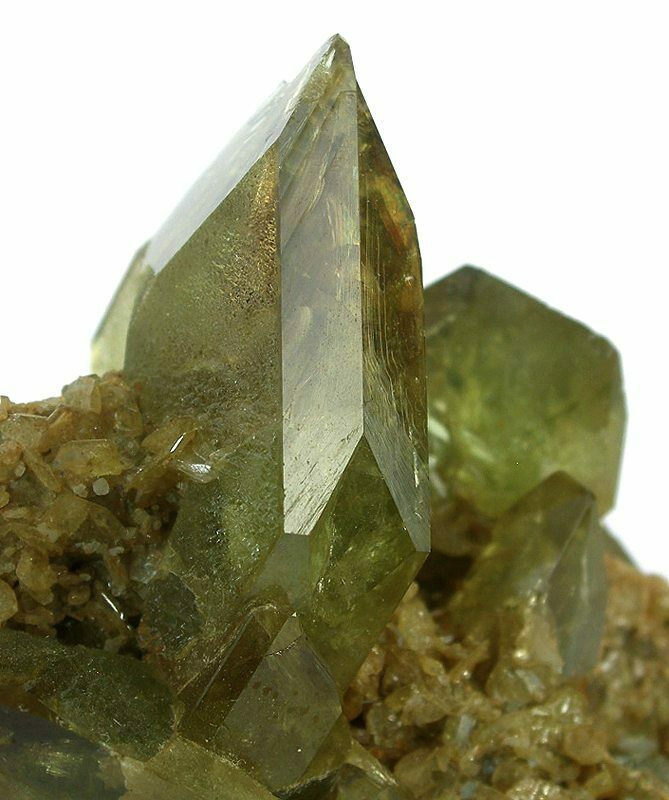
A rough, wedge-shaped Titanite (Sphene) Crystals From Brazil.
Geological Formation Environments
Titanite crystallizes in several major geological settings:
1. Metamorphic Rocks
Titanite is abundant in gneiss, schist, marble, amphibolite, and granulite facies rocks. During regional metamorphism, calcium from carbonate or feldspar combines with titanium mobilized from precursor minerals (like ilmenite or rutile) and silica from quartz or feldspar to form titanite. In high-grade metamorphic terrains, titanite is an important index mineral for pressure-temperature (P-T) path reconstruction.
2. Alkaline Igneous Rocks
Titanite thrives in alkaline and silica-undersaturated igneous systems, including syenite, nepheline syenite, phonolite, carbonatite, and pegmatites. It is particularly common in carbonatite complexes, where calcium is abundant and titanium is concentrated in late-stage fluids.
3. Skarns and Contact Metamorphic Zones
In skarn deposits (formed when magma intrudes limestone), titanite grows alongside garnet, diopside, vesuvianite, apatite, and magnetite. These crystals can be exceptionally large and sharply formed.
4. Alpine Clefts and Hydrothermal Veins
Some of the world’s most aesthetic titanite specimens come from Alpine-type clefts in the European Alps (especially Switzerland and Austria). These crystals are often transparent, lustrous, and dramatic in shape, perched on matrix minerals like chlorite, adularia, albite, or calcite.
Titanite as a Scientific Time Capsule
Titanite is a workhorse mineral in U-Pb geochronology. It incorporates uranium into its crystal lattice while rejecting lead during formation. Over time, uranium decays to lead at a known rate, allowing precise age determination. Unlike zircon, which is so robust it often preserves its original age even after multiple heating events, titanite is more thermally sensitive and can reset during metamorphism at ~600–700 °C. This makes titanite uniquely powerful for answering questions like:
Because it recrystallizes more easily, titanite can record multiple generations within the same rock, sometimes preserving older cores with younger rims—similar to tree rings, but written in isotopes. Titanite is also used in thermochronology to track cooling histories, and in trace-element analysis to infer the chemistry of ancient hydrothermal fluids.
Notable Localities
Some famous titanite-producing regions include:
Switzerland (Alps): Classic alpine cleft crystals, museum-quality
Austria (Zillertal, Tyrol): Transparent, sharp, high-luster crystals
Pakistan (Shigar Valley, Skardu): Large green-gold crystals, gem-grade
Madagascar: Yellow-green gem material
Canada (Ontario): Occurs in metamorphic and alkaline igneous rocks
Russia (Kola Peninsula): Titanite in alkaline complexes
Mexico: Found in skarns
Gemology and Market Notes
In the gem world, faceted sphene is treasured for its diamond-beating fire, but its softness and imperfect cleavage make cutting risky. Stones can chip during faceting, polishing requires finesse, and gems demand protective settings in jewelry. For mineral collectors, however, titanite hits a sweet spot: high brilliance + complex crystal forms + strong locality appeal, with specimens that display beautifully even when untouched by gem cutting.


