 Reviews

Veszelyite - Mineral & Crystal Guide
Some minerals feel like they belong in the spotlight—towering quartz points, fiery opals, or gleaming sheets of mica. But veszelyite is different. It is one of those rare minerals that seems almost secretive, appearing not in massive veins or obvious gemstone pockets, but as delicate flashes of electric blue and deep sea-green tucked into the forgotten corners of oxidized ore deposits. Finding it often feels less like mining and more like discovering a hidden brushstroke of color left behind by nature.
At first glance, veszelyite can look almost unreal. Its crystals are often small—sometimes only a few millimeters long—but they have a striking, glassy brilliance that makes them stand out sharply against pale quartz or rusty ironstone. The best specimens look like tiny shards of turquoise glass sprinkled across the rock, as if a mineral painter dusted the surface with pigment. Collectors are especially drawn to its vivid hues, which come from its copper content, the same element responsible for the colors of malachite and azurite.
Yet veszelyite is far rarer than those famous copper minerals. In fact, many seasoned collectors go their entire lives without seeing a good crystal in person. It forms only under a narrow set of chemical conditions, requiring not just copper, but also zinc, phosphate, hydroxyl groups, and water—all coming together at just the right moment in the oxidation zone of a deposit. That combination makes it something of a geological coincidence: a mineral born from the perfect intersection of elements and environment.
What makes veszelyite especially fascinating is that it belongs to the world of secondary minerals—those created not in the deep heat of Earth’s interior, but in the near-surface realm where rock is actively breaking down. These are minerals of transformation and change, forming as groundwater and oxygen slowly rewrite the chemistry of older ores. Veszelyite is part of this constantly evolving mineral ecosystem, crystallizing in places where copper and zinc deposits are being weathered and reworked over time.
Adding to its mystique is the fact that veszelyite was first described in the 19th century from the mines of Romania, a region already steeped in mineralogical history. Its name honors Ágost Veszely, a Hungarian mining engineer, linking the mineral forever to the human story of exploration, industry, and scientific discovery. Like many rare phosphates, it sits at the crossroads of beauty and obscurity: not widely known outside collector circles, but unforgettable once encountered.
Mineral class: Phosphates (hydrated phosphate with hydroxyl)
Chemical formula: commonly given as (Cu,Zn)₂Zn(PO₄)(OH)₃·2H₂O
Crystal system: Monoclinic
Color: green, blue, greenish blue to dark blue
Luster: Vitreous (glassy)
Mohs hardness: 3½–4
Specific gravity: about 3.4
Common crystal habit: slender prismatic / wedge-shaped crystals; granular aggregates
Commonly associated minerals: pseudomalachite, malachite, hemimorphite, pyromorphite, libethenite, quartz, iron oxides
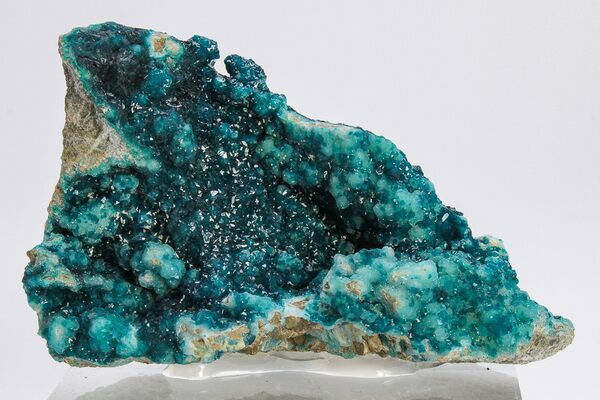
2.8" Spectacular Veszelyite Crystal Cluster on Hemimorphite Matrix – Democratic Republic of Congo
Veszelyite is best understood as a late-stage “weathering-zone” mineral—a product of ongoing chemical reactions that take place where oxygen-rich groundwater penetrates older, sulfide-rich ore bodies. In the oxidized zones of base-metal deposits, primary minerals—especially copper- and zinc-bearing sulfides—begin to decompose as they are exposed to air and circulating water. As this breakdown progresses, copper and zinc are released into solution, while groundwater can introduce phosphate into the system. When the chemistry aligns—under the right balance of pH, oxidation state (Eh), and available water—these components combine to crystallize a hydrated copper–zinc phosphate such as veszelyite.
Because it forms in this dynamic, near-surface environment, veszelyite is typically rare and highly localized, appearing only where very specific chemical conditions briefly coincide. It most often occurs as small but sharply formed crystals perched on matrix rock, their crisp edges reflecting the delicate balance of factors that allowed them to grow. In these oxidation zones—sometimes described as nature’s own mineral-processing laboratory—veszelyite forms alongside a suite of other secondary copper and zinc minerals, all products of the same slow chemical transformation reshaping the original ore.
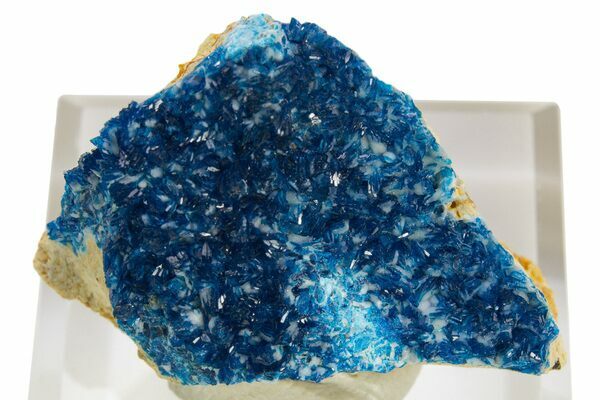
1.2" Vibrant Blue Veszelyite Crystals on Hemimorphite Matrix – China
The story of veszelyite begins in the mineral-rich mountains of 19th-century Europe, at a time when mining districts were not only sources of industrial wealth, but also frontiers of scientific discovery. In 1874, deep within the workings of Ocna de Fier in Romania—a region already famous for its complex ore deposits—miners and mineralogists encountered an unusual blue-green phosphate mineral unlike anything that had been formally described before.
It was the Austrian mineralogist Albrecht Schrauf who studied the material and recognized it as a distinct new species. In an era when mineral classification was still developing rapidly, the identification of a new mineral carried a sense of excitement and permanence: another small piece of Earth’s chemical puzzle had been named and placed into the growing framework of mineral science.
Schrauf chose to name the mineral veszelyite in honor of Ágost (Gusztáv) Veszely, a Hungarian mining engineer connected with the locality and its discovery. Like many minerals named in the 1800s, veszelyite preserves a human legacy within its crystal structure—an enduring tribute to the people who mapped, worked, and studied the subterranean world.
Despite its vivid beauty, veszelyite never became a mineral of industry. It is far too rare and forms in quantities far too small to serve as an ore of copper or zinc. Instead, its value has always been found elsewhere. For collectors, veszelyite is treasured as one of the more striking and elusive secondary phosphates, admired for its saturated colors and sharp crystal forms. For scientists, it offers insight into the complex chemical processes that occur in the oxidized zones of ore deposits, where groundwater and oxygen slowly transform older sulfide minerals into entirely new suites of secondary species.
Ocna de Fier is the mineral’s type locality, the place where it was first recognized and described in 1874. For collectors, “type locality” carries a particular romance: even modest specimens connect directly to the moment a new species entered science. Material here is often more about historical significance than giant crystals, but it remains a cornerstone locality for anyone building a focused phosphate or type-mineral collection.
If you’ve seen photos of “textbook” veszelyite crystals—lustrous blue-green prisms with strong presence—they often trace back to Black Pine Mine. This locality is widely regarded for producing some of the best, largest, and sharpest crystals known from the United States, elevating an otherwise scarce species into something collectors can dream about owning in display quality.
Kipushi is famous for an entire suite of spectacular secondary minerals, and veszelyite appears there as part of a rich oxidized-zone chemistry set. The locality is repeatedly cited in distribution summaries for the species, and it’s also known for associations with other copper minerals and oxidized-zone products—exactly the environment where a hydrated Cu–Zn phosphate should thrive.
Kabwe (historically “Broken Hill”) is another classic base-metal district where oxidation-zone mineralogy can be astonishingly diverse. Veszelyite from Kabwe is an example of how the mineral can show up in lead–zinc systems as well, provided phosphate is available and copper participates in the chemistry. It’s a locality often listed alongside Kipushi and Ocna de Fier in authoritative distribution accounts.
Wanlockhead is a storied Scottish mining area where oxidized-zone minerals form in veins and old workings—conditions that can produce unexpected phosphate species. For veszelyite collectors, Wanlockhead stands out as a classic European occurrence outside the more frequently discussed Romania–Africa–USA set, and the association list from this district underscores how closely veszelyite tracks with familiar secondary copper and zinc minerals.

At first glance, veszelyite can look almost unreal. Its crystals are often small—sometimes only a few millimeters long—but they have a striking, glassy brilliance that makes them stand out sharply against pale quartz or rusty ironstone. The best specimens look like tiny shards of turquoise glass sprinkled across the rock, as if a mineral painter dusted the surface with pigment. Collectors are especially drawn to its vivid hues, which come from its copper content, the same element responsible for the colors of malachite and azurite.
Yet veszelyite is far rarer than those famous copper minerals. In fact, many seasoned collectors go their entire lives without seeing a good crystal in person. It forms only under a narrow set of chemical conditions, requiring not just copper, but also zinc, phosphate, hydroxyl groups, and water—all coming together at just the right moment in the oxidation zone of a deposit. That combination makes it something of a geological coincidence: a mineral born from the perfect intersection of elements and environment.
What makes veszelyite especially fascinating is that it belongs to the world of secondary minerals—those created not in the deep heat of Earth’s interior, but in the near-surface realm where rock is actively breaking down. These are minerals of transformation and change, forming as groundwater and oxygen slowly rewrite the chemistry of older ores. Veszelyite is part of this constantly evolving mineral ecosystem, crystallizing in places where copper and zinc deposits are being weathered and reworked over time.
Adding to its mystique is the fact that veszelyite was first described in the 19th century from the mines of Romania, a region already steeped in mineralogical history. Its name honors Ágost Veszely, a Hungarian mining engineer, linking the mineral forever to the human story of exploration, industry, and scientific discovery. Like many rare phosphates, it sits at the crossroads of beauty and obscurity: not widely known outside collector circles, but unforgettable once encountered.
Quick Properties
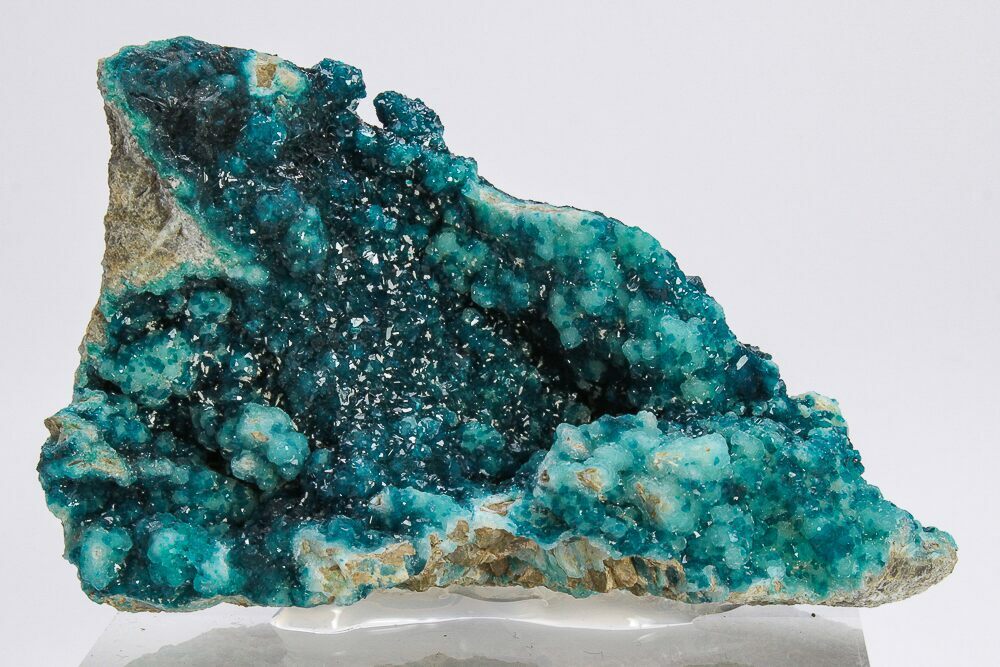
2.8" Spectacular Veszelyite Crystal Cluster on Hemimorphite Matrix – Democratic Republic of Congo
How Veszelyite Forms
Veszelyite is best understood as a late-stage “weathering-zone” mineral—a product of ongoing chemical reactions that take place where oxygen-rich groundwater penetrates older, sulfide-rich ore bodies. In the oxidized zones of base-metal deposits, primary minerals—especially copper- and zinc-bearing sulfides—begin to decompose as they are exposed to air and circulating water. As this breakdown progresses, copper and zinc are released into solution, while groundwater can introduce phosphate into the system. When the chemistry aligns—under the right balance of pH, oxidation state (Eh), and available water—these components combine to crystallize a hydrated copper–zinc phosphate such as veszelyite.
Because it forms in this dynamic, near-surface environment, veszelyite is typically rare and highly localized, appearing only where very specific chemical conditions briefly coincide. It most often occurs as small but sharply formed crystals perched on matrix rock, their crisp edges reflecting the delicate balance of factors that allowed them to grow. In these oxidation zones—sometimes described as nature’s own mineral-processing laboratory—veszelyite forms alongside a suite of other secondary copper and zinc minerals, all products of the same slow chemical transformation reshaping the original ore.
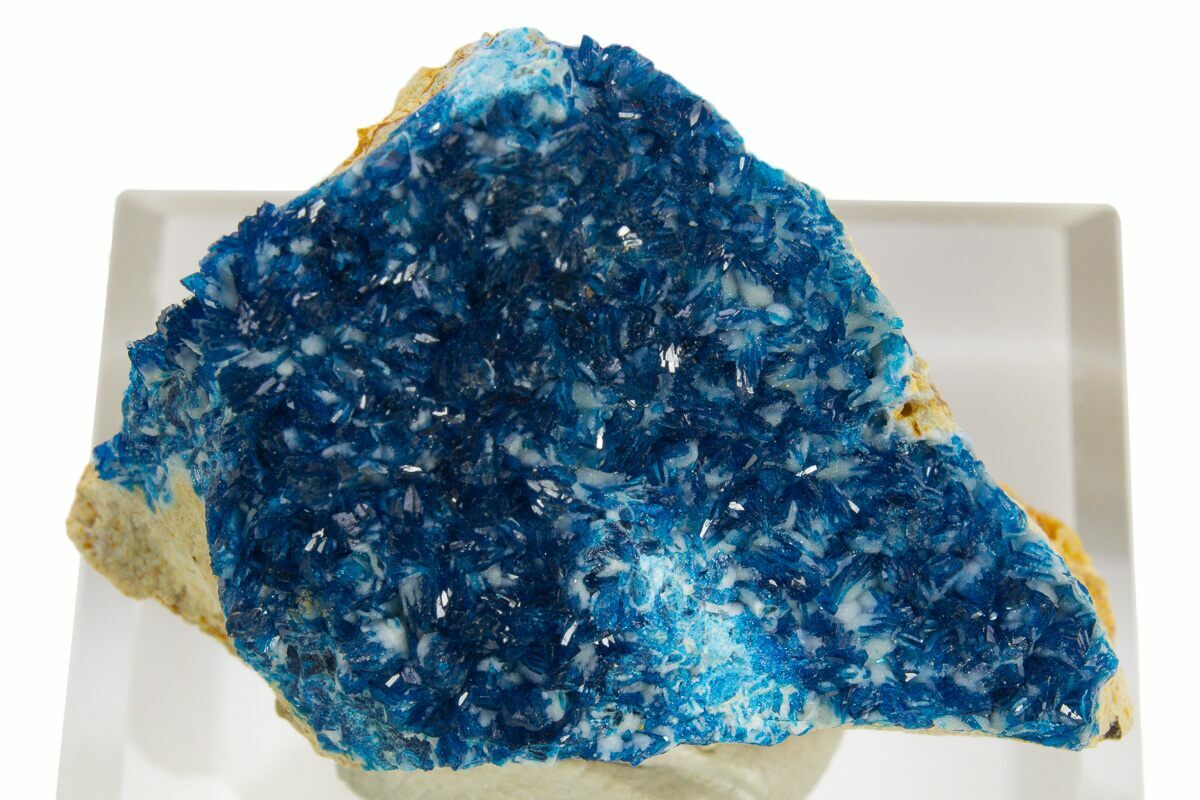
1.2" Vibrant Blue Veszelyite Crystals on Hemimorphite Matrix – China
History & Uses
The story of veszelyite begins in the mineral-rich mountains of 19th-century Europe, at a time when mining districts were not only sources of industrial wealth, but also frontiers of scientific discovery. In 1874, deep within the workings of Ocna de Fier in Romania—a region already famous for its complex ore deposits—miners and mineralogists encountered an unusual blue-green phosphate mineral unlike anything that had been formally described before.
It was the Austrian mineralogist Albrecht Schrauf who studied the material and recognized it as a distinct new species. In an era when mineral classification was still developing rapidly, the identification of a new mineral carried a sense of excitement and permanence: another small piece of Earth’s chemical puzzle had been named and placed into the growing framework of mineral science.
Schrauf chose to name the mineral veszelyite in honor of Ágost (Gusztáv) Veszely, a Hungarian mining engineer connected with the locality and its discovery. Like many minerals named in the 1800s, veszelyite preserves a human legacy within its crystal structure—an enduring tribute to the people who mapped, worked, and studied the subterranean world.
Despite its vivid beauty, veszelyite never became a mineral of industry. It is far too rare and forms in quantities far too small to serve as an ore of copper or zinc. Instead, its value has always been found elsewhere. For collectors, veszelyite is treasured as one of the more striking and elusive secondary phosphates, admired for its saturated colors and sharp crystal forms. For scientists, it offers insight into the complex chemical processes that occur in the oxidized zones of ore deposits, where groundwater and oxygen slowly transform older sulfide minerals into entirely new suites of secondary species.
Key Collecting Locations
Ocna de Fier, Caraș-Severin County, Romania (type locality)
Ocna de Fier is the mineral’s type locality, the place where it was first recognized and described in 1874. For collectors, “type locality” carries a particular romance: even modest specimens connect directly to the moment a new species entered science. Material here is often more about historical significance than giant crystals, but it remains a cornerstone locality for anyone building a focused phosphate or type-mineral collection.
Black Pine Mine, Philipsburg area, Granite County, Montana, USA
If you’ve seen photos of “textbook” veszelyite crystals—lustrous blue-green prisms with strong presence—they often trace back to Black Pine Mine. This locality is widely regarded for producing some of the best, largest, and sharpest crystals known from the United States, elevating an otherwise scarce species into something collectors can dream about owning in display quality.
Kipushi Mine, Katanga region, DR Congo
Kipushi is famous for an entire suite of spectacular secondary minerals, and veszelyite appears there as part of a rich oxidized-zone chemistry set. The locality is repeatedly cited in distribution summaries for the species, and it’s also known for associations with other copper minerals and oxidized-zone products—exactly the environment where a hydrated Cu–Zn phosphate should thrive.
Kabwe (Broken Hill), Zambia
Kabwe (historically “Broken Hill”) is another classic base-metal district where oxidation-zone mineralogy can be astonishingly diverse. Veszelyite from Kabwe is an example of how the mineral can show up in lead–zinc systems as well, provided phosphate is available and copper participates in the chemistry. It’s a locality often listed alongside Kipushi and Ocna de Fier in authoritative distribution accounts.
Wanlockhead, Dumfriesshire, Scotland
Wanlockhead is a storied Scottish mining area where oxidized-zone minerals form in veins and old workings—conditions that can produce unexpected phosphate species. For veszelyite collectors, Wanlockhead stands out as a classic European occurrence outside the more frequently discussed Romania–Africa–USA set, and the association list from this district underscores how closely veszelyite tracks with familiar secondary copper and zinc minerals.


