 Reviews

Crocoite: Mineral & Crystal Guide
To see a fine crocoite specimen for the first time is to understand why seasoned collectors still stop mid-sentence when one comes out of a box. Its crystals blaze in saturated shades of orange and red so intense they look artificial—like molten glass, fresh lacquer, or embers pulled straight from a fire. In a display case full of minerals, crocoite doesn’t blend in. It dominates.
What makes it even more remarkable is that this color isn’t a surface stain or a trick of lighting. It is intrinsic, bold, and uncompromising. The crystals often grow as long, slender prisms or tightly packed sprays that radiate outward in dramatic clusters. Some resemble bundles of glowing matchsticks. Others form spiky bursts, like fireworks frozen at their peak. When light hits their smooth faces, they flash with a sharp, almost diamond-like brilliance that amplifies the fiery color.
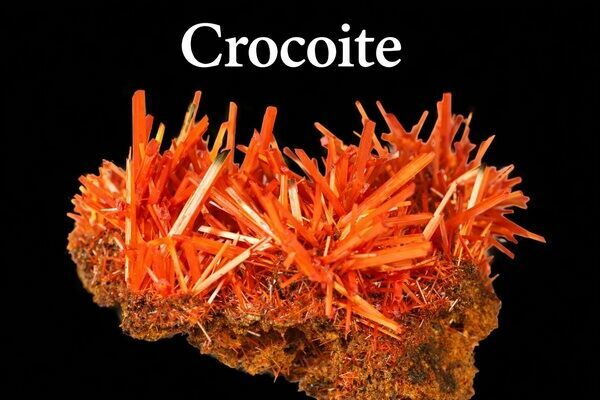
Brilliant orange-red crocoite crystals radiate in fiery sprays from iron-rich matrix, creating one of the most vividly colored mineral displays found in nature.
Despite its vivid appearance, crocoite is surprisingly soft and delicate. Many crystals are brittle, easily damaged, and must be handled with care. Large, undamaged clusters are rare and highly prized because the mineral forms only under very specific natural conditions. It requires the right ingredients, the right environment, and just the right timing. Miss one factor, and crocoite simply doesn’t grow.
That rarity has elevated crocoite to near-mythic status among collectors. The finest specimens—particularly those from western Tasmania—are considered among the most spectacular mineral treasures in the world. In fact, crocoite is so iconic there that it has been recognized as Tasmania’s official mineral, a testament to both its beauty and its regional importance.
Crocoite also carries historical weight. In the late 1700s, scientists studying this bright red mineral made an important discovery: it led directly to the identification of a new metallic element. From a glowing crystal pulled from a Russian mine came insights that would eventually influence pigments, metallurgy, and industry around the globe. Few minerals can claim to have sparked both aesthetic awe and scientific advancement.
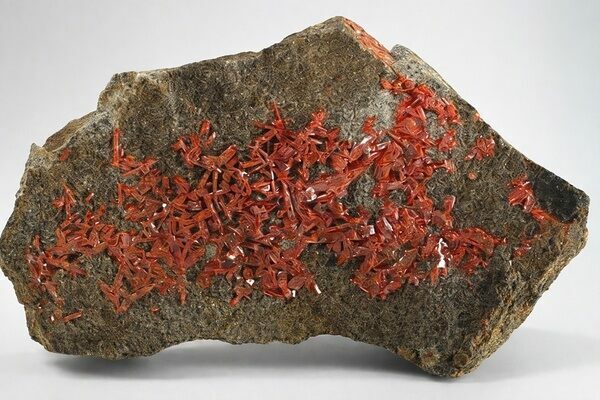
Large and richly crystallized crocoite specimen from the type locality of the Berezovskoe Gold Deposit, Middle Urals, Russia.
There is, too, a certain contradiction in crocoite’s personality. It looks energetic and explosive, yet it forms slowly and quietly underground. It appears powerful and bold, yet it is fragile. It seems almost too bright to be natural, yet it is entirely the work of geology. In the end, crocoite’s appeal is simple and immediate. It looks like fire made permanent—like a flame captured, crystallized, and held still for us to admire.
Chemical formula: PbCrO₄
Mineral class: Chromates
Crystal system: Monoclinic
Typical color: orange, red, yellow; often vivid hyacinth-red/orange-red
Luster: adamantine to vitreous (often strikingly “glassy-brilliant”)
Streak: yellowish-orange
Hardness (Mohs): 2.5–3
Specific gravity: ~5.9–6.1 (notably heavy in hand)
Cleavage: distinct on {110} (with additional, less distinct directions reported)
Common habit: long prismatic to acicular (needle-like) crystals; clusters in vugs
Commonly associated minerals: quartz, limonite/gossan, anglesite, cerussite, pyromorphite, mimetite, wulfenite, vauquelinite, phoenicochroite
Crocoite is best understood as a mineral of the oxidation zone—the chemically active near-surface environment where primary sulfides break down and new, brightly colored secondary minerals crystallize. The lead side of the equation typically comes from the weathering of galena (PbS) or other lead minerals; as oxygenated waters percolate, lead is freed and re-precipitated into secondary species. The chromium side is the harder part: crocoite needs chromium available as chromate (CrO₄²⁻), which generally requires a chromium-bearing source rock (often involving chromite in ultramafic rocks) and oxidizing conditions capable of converting chromium into the chromate form.
Put those requirements together and you can see why crocoite is rare. You need lead-rich mineralization, access to chromium, the right water chemistry, and open space—fractures, vugs, or mine cavities—where crystals can grow. When it works, it can produce spectacular sprays and clusters: the classic “jackstraw” habit collectors love, grown like miniature bundles of glowing matchsticks.
Crocoite’s story begins in the Ural Mountains of Russia in the mid-18th century, where miners working gold deposits encountered a striking red mineral unlike anything they had seen before. It was heavy, vividly colored, and often found in quartz veins cutting through the rock. At first, it was regarded simply as an unusual “red lead ore,” valued more for curiosity than for commerce. Its color—rich, saffron-red—made it stand out even in an era when new mineral discoveries were reshaping European science.
Specimens made their way into the hands of mineralogists, and by the late 1700s, crocoite would quietly change chemistry. In 1797, French chemist Louis Nicolas Vauquelin analyzed the mineral and identified within it a previously unknown metallic element. That element would be named chromium, from the Greek word for color, a nod to the brilliant compounds it produced. It was an appropriate tribute—crocoite itself had provided the clue. From a glowing crystal pulled from a Russian mine came a discovery that would ripple outward into pigments, alloys, and industrial materials used around the world.
For a time, crocoite’s composition became important in the development of vivid yellow and orange pigments. Compounds derived from chromium helped create the famous “chrome yellow” used in paints during the 19th century. These pigments found their way into everything from fine art to house paint and even early school buses. While crocoite itself was far too rare to serve as a practical ore, it stood at the beginning of that story—a mineralogical stepping stone that unlocked a new palette of color for artists and industry alike.
As the science progressed, however, so did awareness of toxicity. Crocoite contains lead and chromium in forms that can be hazardous. By modern standards, it is handled carefully and never used directly in consumer products. Its role shifted from industrial relevance to scientific and aesthetic importance.
In the 19th century, as mineral collecting became fashionable among European aristocracy and academics, crocoite gained prestige. Cabinets of curiosities proudly displayed its fiery crystals, and it earned a reputation as one of the most visually dramatic minerals known. When spectacular material was later discovered in Tasmania, crocoite’s status rose even higher. The Tasmanian finds transformed it from a scientific footnote into a collector’s legend.
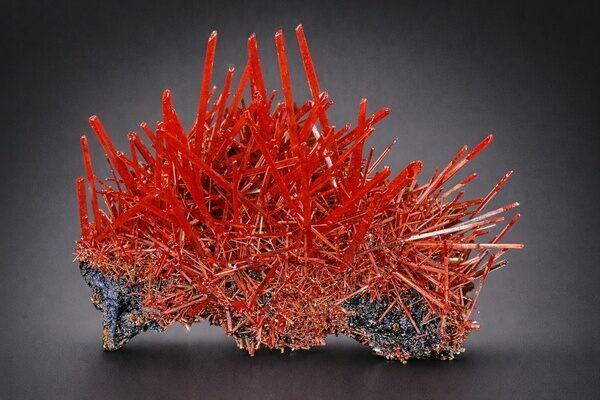
Crocoite crystal cluster from the Adelaide Mine, Dundas mineral field, Zeehan District, Tasmania, Australia — ex. Albert Chapman collection (1973).
Today, crocoite’s “use” is almost entirely inspirational. It is prized in museums and private collections, photographed endlessly, and admired for its improbable intensity. It tells a layered story: of early miners in the Urals, of chemists uncovering new elements, of artists expanding their range of color, and of collectors chasing beauty in its purest mineral form.
Crocoite is rare worldwide, but a handful of localities have produced specimens so spectacular that they’ve become legendary among collectors. These classic sites not only define the mineral’s finest examples, but also tell the geological story of how such fiery crystals come to exist at all.
If crocoite has a world capital, it’s Dundas in western Tasmania. Specimens from mines like the Adelaide and Red Lead have become the benchmark for the species—dense, sculptural sprays of vivid crystals perched on iron-rich gossan. The district’s legacy is so strong that crocoite is even recognized as Tasmania’s mineral emblem, and multiple classic Dundas mines are noted for producing the finest examples. The locality matters because it demonstrates “ideal” crocoite conditions: oxidized lead zones intersecting a chromium source and open pockets that allow crystals to grow large, bright, and well displayed.
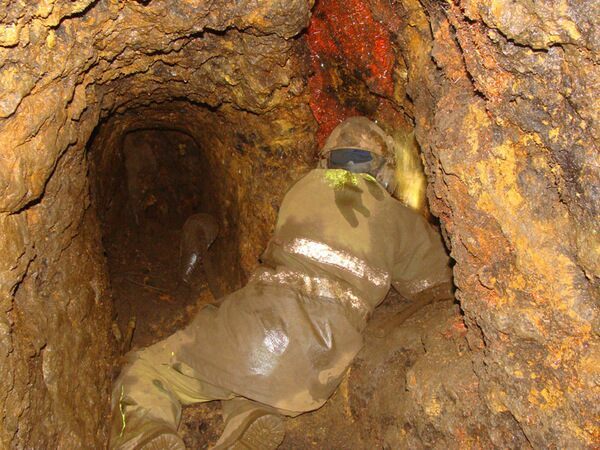
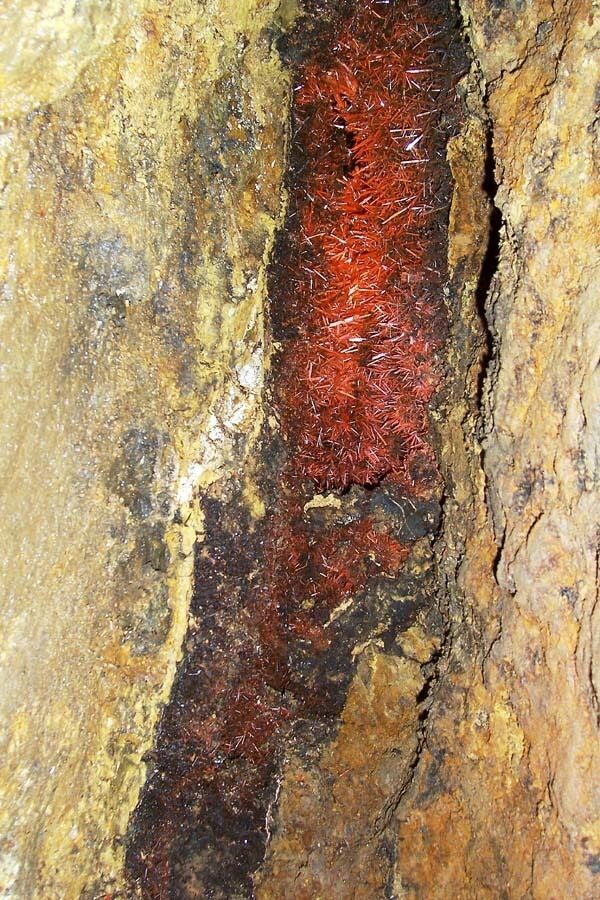
Mining a crocoite pocket in the Adelaide mine.
The Urals are crocoite’s origin point in the scientific record. At Berezovsk, crocoite occurs in quartz veins associated with gold-bearing systems, a setting that helped early mineralogists treat it as a distinct mineral rather than just another “red lead ore.” This locality is historically important not only because it’s the type area, but because crocoite from the Urals sits at the crossroads of mineral collecting and the birth of chromium chemistry—linking a mine vein to a laboratory discovery.
Germany’s Callenberg is a celebrated European crocoite site—widely regarded as a “famous crocoite locality” in its own right. Callenberg specimens are typically smaller than the grandest Tasmanian pieces, but they can show intensely colored crystals on iron-rich matrix, prized because the locality is both classic and comparatively limited in output. For collectors, Callenberg represents the “other look” of crocoite: tight, well-formed crystals in dramatic contrast against earthy host rock.
Brazil is less commonly associated with crocoite than Tasmania or the Urals, which is exactly why its occurrences are so interesting. Localities near Congonhas (including the Goiabeira Mine) are documented sources of Brazilian crocoite specimens. In these settings, crocoite typically appears as a secondary mineral tied to oxidized lead environments where chromium is also available—producing pieces that collectors value for locality diversity and the distinctive “warm” Brazilian aesthetic that can differ from the needle-spray stereotype.
In the United States, crocoite is known from scattered oxidation-zone lead occurrences, including parts of Riverside and Inyo counties in California. These localities generally don’t rival Tasmania in volume or fame, but they’re important for illustrating that crocoite isn’t confined to one geologic story—wherever lead deposits weather in the presence of a chromium source under oxidizing conditions, nature can occasionally “switch on” the same brilliant PbCrO₄ chemistry and grow crocoite in pockets and fractures.
What makes it even more remarkable is that this color isn’t a surface stain or a trick of lighting. It is intrinsic, bold, and uncompromising. The crystals often grow as long, slender prisms or tightly packed sprays that radiate outward in dramatic clusters. Some resemble bundles of glowing matchsticks. Others form spiky bursts, like fireworks frozen at their peak. When light hits their smooth faces, they flash with a sharp, almost diamond-like brilliance that amplifies the fiery color.
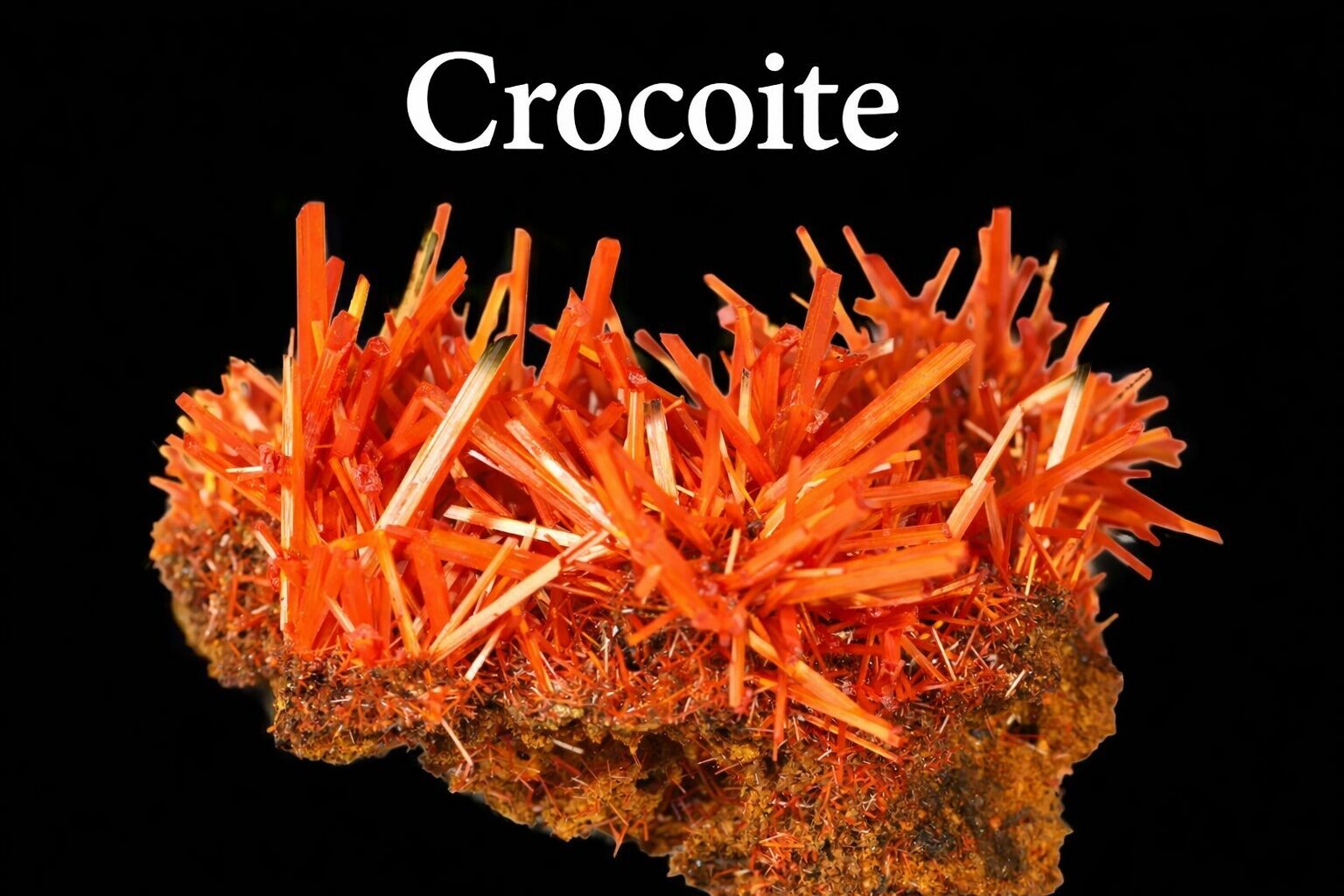
Brilliant orange-red crocoite crystals radiate in fiery sprays from iron-rich matrix, creating one of the most vividly colored mineral displays found in nature.
Despite its vivid appearance, crocoite is surprisingly soft and delicate. Many crystals are brittle, easily damaged, and must be handled with care. Large, undamaged clusters are rare and highly prized because the mineral forms only under very specific natural conditions. It requires the right ingredients, the right environment, and just the right timing. Miss one factor, and crocoite simply doesn’t grow.
That rarity has elevated crocoite to near-mythic status among collectors. The finest specimens—particularly those from western Tasmania—are considered among the most spectacular mineral treasures in the world. In fact, crocoite is so iconic there that it has been recognized as Tasmania’s official mineral, a testament to both its beauty and its regional importance.
Crocoite also carries historical weight. In the late 1700s, scientists studying this bright red mineral made an important discovery: it led directly to the identification of a new metallic element. From a glowing crystal pulled from a Russian mine came insights that would eventually influence pigments, metallurgy, and industry around the globe. Few minerals can claim to have sparked both aesthetic awe and scientific advancement.
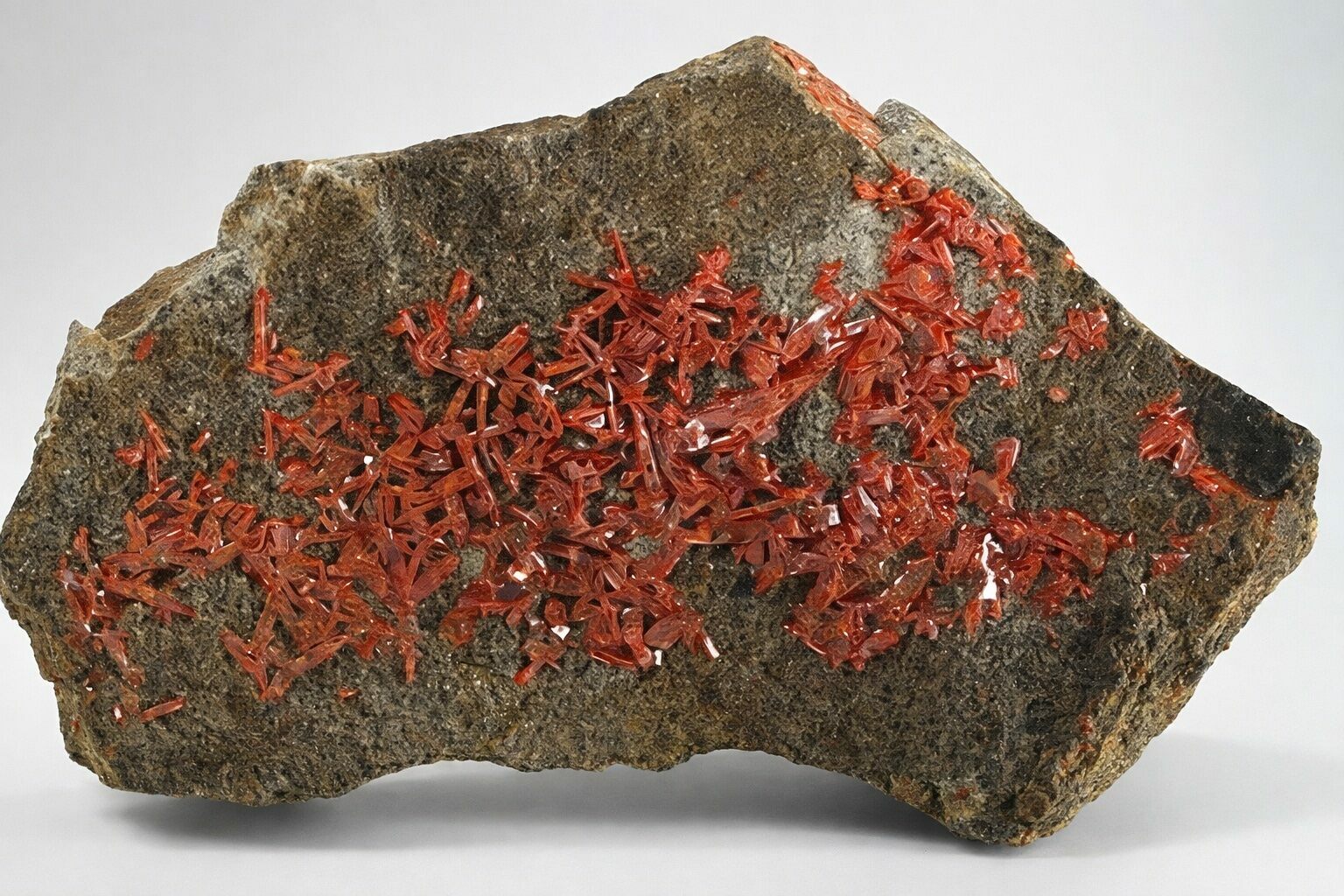
Large and richly crystallized crocoite specimen from the type locality of the Berezovskoe Gold Deposit, Middle Urals, Russia.
There is, too, a certain contradiction in crocoite’s personality. It looks energetic and explosive, yet it forms slowly and quietly underground. It appears powerful and bold, yet it is fragile. It seems almost too bright to be natural, yet it is entirely the work of geology. In the end, crocoite’s appeal is simple and immediate. It looks like fire made permanent—like a flame captured, crystallized, and held still for us to admire.
Properties Of Crocoite
How Crocoite Forms
Crocoite is best understood as a mineral of the oxidation zone—the chemically active near-surface environment where primary sulfides break down and new, brightly colored secondary minerals crystallize. The lead side of the equation typically comes from the weathering of galena (PbS) or other lead minerals; as oxygenated waters percolate, lead is freed and re-precipitated into secondary species. The chromium side is the harder part: crocoite needs chromium available as chromate (CrO₄²⁻), which generally requires a chromium-bearing source rock (often involving chromite in ultramafic rocks) and oxidizing conditions capable of converting chromium into the chromate form.
Put those requirements together and you can see why crocoite is rare. You need lead-rich mineralization, access to chromium, the right water chemistry, and open space—fractures, vugs, or mine cavities—where crystals can grow. When it works, it can produce spectacular sprays and clusters: the classic “jackstraw” habit collectors love, grown like miniature bundles of glowing matchsticks.
History & Uses Of Crocoite
Crocoite’s story begins in the Ural Mountains of Russia in the mid-18th century, where miners working gold deposits encountered a striking red mineral unlike anything they had seen before. It was heavy, vividly colored, and often found in quartz veins cutting through the rock. At first, it was regarded simply as an unusual “red lead ore,” valued more for curiosity than for commerce. Its color—rich, saffron-red—made it stand out even in an era when new mineral discoveries were reshaping European science.
Specimens made their way into the hands of mineralogists, and by the late 1700s, crocoite would quietly change chemistry. In 1797, French chemist Louis Nicolas Vauquelin analyzed the mineral and identified within it a previously unknown metallic element. That element would be named chromium, from the Greek word for color, a nod to the brilliant compounds it produced. It was an appropriate tribute—crocoite itself had provided the clue. From a glowing crystal pulled from a Russian mine came a discovery that would ripple outward into pigments, alloys, and industrial materials used around the world.
For a time, crocoite’s composition became important in the development of vivid yellow and orange pigments. Compounds derived from chromium helped create the famous “chrome yellow” used in paints during the 19th century. These pigments found their way into everything from fine art to house paint and even early school buses. While crocoite itself was far too rare to serve as a practical ore, it stood at the beginning of that story—a mineralogical stepping stone that unlocked a new palette of color for artists and industry alike.
As the science progressed, however, so did awareness of toxicity. Crocoite contains lead and chromium in forms that can be hazardous. By modern standards, it is handled carefully and never used directly in consumer products. Its role shifted from industrial relevance to scientific and aesthetic importance.
In the 19th century, as mineral collecting became fashionable among European aristocracy and academics, crocoite gained prestige. Cabinets of curiosities proudly displayed its fiery crystals, and it earned a reputation as one of the most visually dramatic minerals known. When spectacular material was later discovered in Tasmania, crocoite’s status rose even higher. The Tasmanian finds transformed it from a scientific footnote into a collector’s legend.
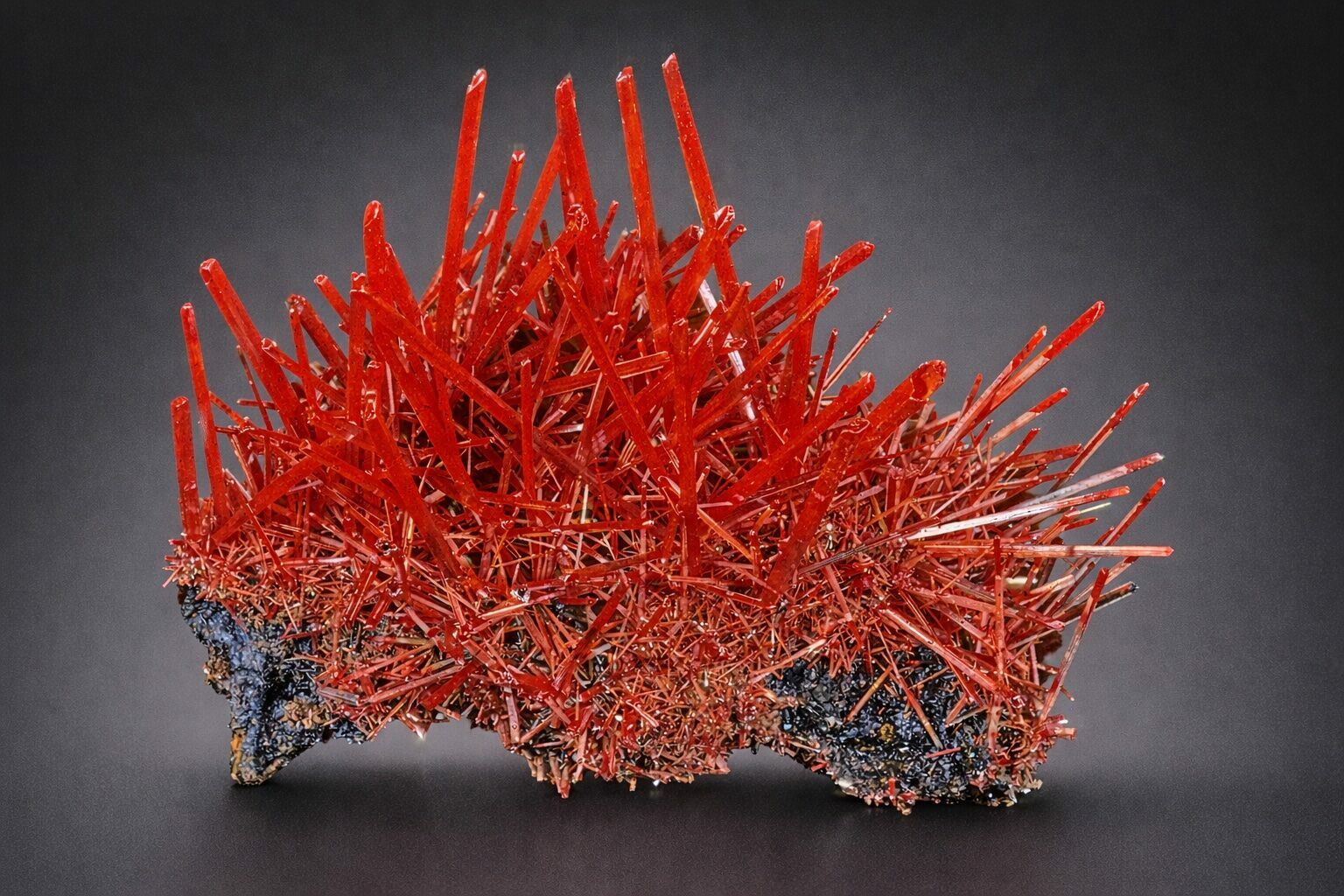
Crocoite crystal cluster from the Adelaide Mine, Dundas mineral field, Zeehan District, Tasmania, Australia — ex. Albert Chapman collection (1973).
Today, crocoite’s “use” is almost entirely inspirational. It is prized in museums and private collections, photographed endlessly, and admired for its improbable intensity. It tells a layered story: of early miners in the Urals, of chemists uncovering new elements, of artists expanding their range of color, and of collectors chasing beauty in its purest mineral form.
Key Localities
Crocoite is rare worldwide, but a handful of localities have produced specimens so spectacular that they’ve become legendary among collectors. These classic sites not only define the mineral’s finest examples, but also tell the geological story of how such fiery crystals come to exist at all.
Dundas mineral field, Tasmania, Australia (Adelaide, Red Lead & West Comet Mines)
If crocoite has a world capital, it’s Dundas in western Tasmania. Specimens from mines like the Adelaide and Red Lead have become the benchmark for the species—dense, sculptural sprays of vivid crystals perched on iron-rich gossan. The district’s legacy is so strong that crocoite is even recognized as Tasmania’s mineral emblem, and multiple classic Dundas mines are noted for producing the finest examples. The locality matters because it demonstrates “ideal” crocoite conditions: oxidized lead zones intersecting a chromium source and open pockets that allow crystals to grow large, bright, and well displayed.
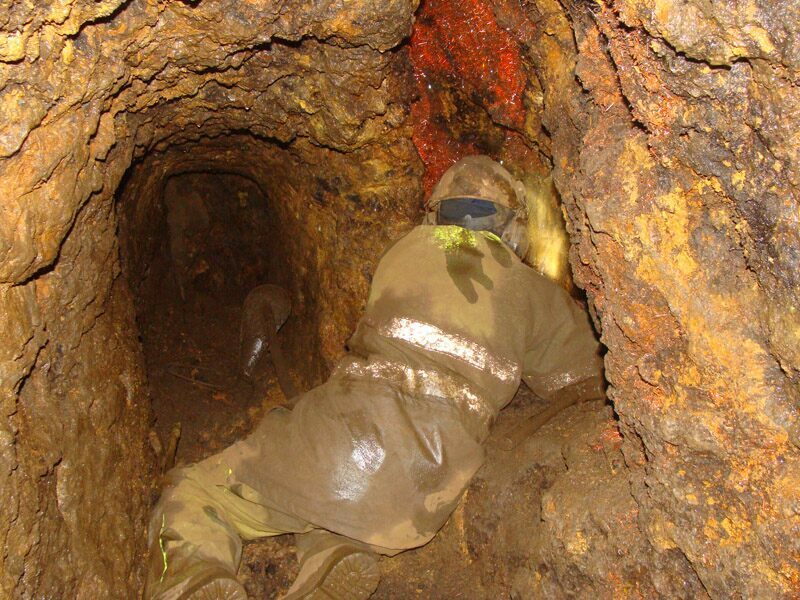
Mining a crocoite pocket in the Adelaide mine.
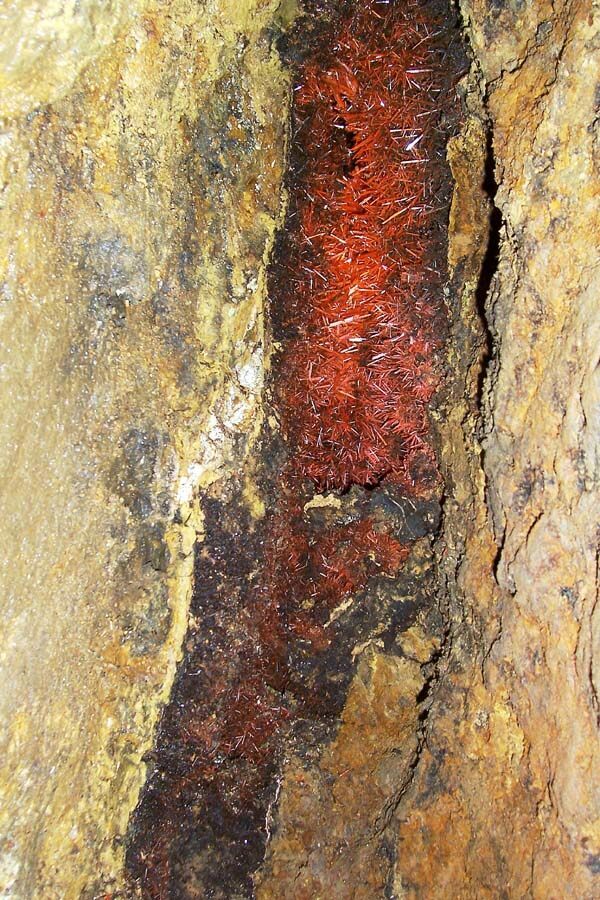
Berezovsk (Beryozovsky) deposit, Ural Mountains, Russia (type locality)
The Urals are crocoite’s origin point in the scientific record. At Berezovsk, crocoite occurs in quartz veins associated with gold-bearing systems, a setting that helped early mineralogists treat it as a distinct mineral rather than just another “red lead ore.” This locality is historically important not only because it’s the type area, but because crocoite from the Urals sits at the crossroads of mineral collecting and the birth of chromium chemistry—linking a mine vein to a laboratory discovery.
Callenberg, Saxony, Germany (Callenberg North open cut No. 1)
Germany’s Callenberg is a celebrated European crocoite site—widely regarded as a “famous crocoite locality” in its own right. Callenberg specimens are typically smaller than the grandest Tasmanian pieces, but they can show intensely colored crystals on iron-rich matrix, prized because the locality is both classic and comparatively limited in output. For collectors, Callenberg represents the “other look” of crocoite: tight, well-formed crystals in dramatic contrast against earthy host rock.
Congonhas area, Minas Gerais, Brazil (including Goiabeira Mine)
Brazil is less commonly associated with crocoite than Tasmania or the Urals, which is exactly why its occurrences are so interesting. Localities near Congonhas (including the Goiabeira Mine) are documented sources of Brazilian crocoite specimens. In these settings, crocoite typically appears as a secondary mineral tied to oxidized lead environments where chromium is also available—producing pieces that collectors value for locality diversity and the distinctive “warm” Brazilian aesthetic that can differ from the needle-spray stereotype.
California, USA (notably Riverside and Inyo County occurrences)
In the United States, crocoite is known from scattered oxidation-zone lead occurrences, including parts of Riverside and Inyo counties in California. These localities generally don’t rival Tasmania in volume or fame, but they’re important for illustrating that crocoite isn’t confined to one geologic story—wherever lead deposits weather in the presence of a chromium source under oxidizing conditions, nature can occasionally “switch on” the same brilliant PbCrO₄ chemistry and grow crocoite in pockets and fractures.


