 Reviews

Rainbow Garnets: Nature’s Fireworks Trapped in Stone
Iridescent garnets are among the most mesmerizing and elusive mineral specimens on Earth, prized for their shimmering rainbow flashes that ripple across crystal faces like oil on water. These gems challenge expectations: while most garnet species are celebrated for rich, solid hues—ruby reds, deep greens, honey browns—iridescent garnets dazzle with spectral color play more commonly associated with opal or labradorite. Their rarity, scientific intrigue, and breathtaking beauty make them some of the most coveted garnet specimens for collectors.
Collectors often compare the effect to a thin metallic sheen or the flicker of a hologram. Rotate an iridescent garnet under light and the colors shift instantly, flowing from gold to violet to green in an optical display the mineral world rarely matches. This phenomenon is not caused by surface treatments, polishing tricks, or inclusions—it is entirely natural, born from microscopic structures that bend light.

What Causes the Iridescence?
The color play in iridescent garnets is caused by interference and diffraction of light within the crystal. Two known structural features are responsible:
1. Lamellar Twinning or Exsolution Layers
Many iridescent garnets contain ultra-thin lamellar structures—stacked layers within the crystal only a few hundred nanometers thick. These act like tiny diffraction gratings, splitting white light into its component colors. The exact arrangement of these lamellae determines whether the garnet displays soft metallic sheen, sharp rainbow flashes, or multi-directional iridescence.
2. Thin-Film Interference
Some specimens contain alternating microscopic layers of slightly different chemical composition. When light enters the crystal, part of it reflects off the upper layer while the rest penetrates deeper—causing the reflected waves to interfere with one another and create brilliant colors.
These optical effects are exceptionally uncommon in garnets, which is why iridescent specimens attract so much scientific interest. Research on examples from Japan (Nara), Norway (Fem-minutter’n), and several other small occurrences shows that the phenomenon requires unusual geological conditions, slow cooling rates, and precise chemical environments.
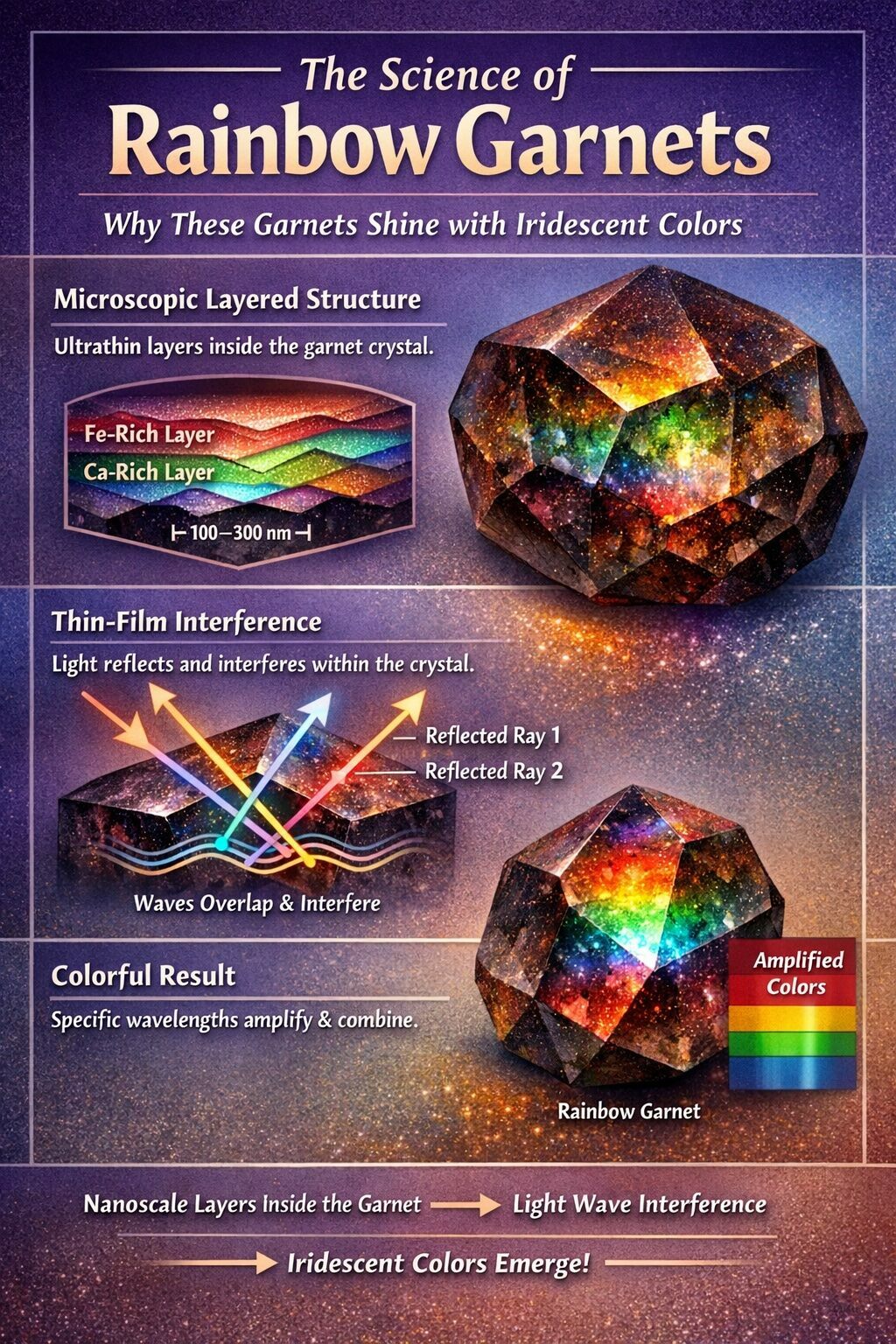
Infographic: What Causes Iridescence In Some Garnets
Where Iridescent Garnets Are Found
Iridescent garnets occur in only a handful of places worldwide, and most localities have produced extremely limited quantities. The three most notable are:
Norway – Buskerud (Fem-minutter’n)
One of the rarest and most spectacular occurrences, Norway’s iridescent andradite garnets display intense rainbow diffraction and often occur with quartz. Only a very small amount has been collected, and mining is extremely restricted. Many of these specimens show sharp geometric crystal faces that shimmer with bold metallic greens, violets, and golds.
Japan – Nara Prefecture
The classic locality studied by mineralogists for decades, famous for andradite garnets whose iridescence arises from well-defined lamellar structures. The colors tend to be softer and more pastel than those of Norway.
Russia, Mexico, and Other Localities
A few small deposits have produced limited quantities, though most examples are micro specimens or partial crystals. These tend to be collector curiosities rather than major sources.
Because each occurrence is geologically unique, no two localities produce identical iridescence. Some show fine metallic sheen; others flash with vivid rainbow bands. All are rare.
What Species of Garnet Are Iridescent?
While garnet is a broad group of minerals, iridescence is overwhelmingly associated with:
The most famous iridescent specimens are andradite-group garnets, which naturally display high dispersion and strong luster—traits that amplify the optical effects.
How Iridescent Garnets Form
Iridescent garnets form under highly specific geological conditions, most often within contact metamorphic skarns where hot, mineral-rich fluids react with limestone or other carbonate rocks. Their development requires the right chemical environment—typically chromium- or iron-rich compositions—to produce dark, lustrous garnets capable of strong light reflection. Equally important is slow, steady cooling, which allows the microscopic internal layers responsible for iridescence to develop without disruption. These crystals also need consistent high-pressure, high-temperature conditions to create the uniform structures that diffract light so dramatically, and they must avoid later alteration, as reheating or deformation can erase the delicate lamellae entirely. Because all of these factors must align perfectly, iridescent garnets remain exceptionally rare in nature.


