 Reviews

Sodalite: Mineral & Crystal Guide
Sodalite has always had a way of pulling people in. Its royal-blue color, often laced with winding white veins, resembles a piece of the night sky tangled in winter clouds. Though frequently mistaken for lapis lazuli, sodalite carries its own geological signature and a quieter history—one rooted not in ancient trade routes, but in 19th-century scientific discovery. It is a sodium-rich aluminosilicate mineral in the tectosilicate family, meaning its atoms are arranged in an interconnected 3-D framework of silica and aluminum tetrahedra. That structure gives sodalite both its durability and its sometimes startling optical effects, including a rare ability to fluoresce bright orange-red under UV light when hackmanite (its sulfur-rich variety) is present.
The mineral’s story begins officially in 1811 when it was first described in Greenland, but it remained largely a laboratory curiosity for decades. That changed dramatically in 1891 when vast deposits were discovered in Ontario, Canada, near Bancroft. Canadian sodalite was later propelled into the spotlight after being selected as a decorative stone for the interior of the Parliament Buildings in Ottawa. Its rise in popularity surged again in the early 1900s when massive quantities were uncovered in Brazil—deposits that would eventually supply global markets with carvable rough, polished slabs, spheres, and lapidary stone.
But sodalite’s origins are far older than its name. The conditions that form it are relatively uncommon. Unlike quartz, which thrives in silica-rich environments, sodalite crystallizes in silica-poor, alkaline igneous rocks, especially nepheline syenite, phonolite, and other feldspathoid-bearing formations. Deep underground, magma enriched with sodium, chlorine, and aluminum cools slowly enough for sodalite’s cage-like crystal lattice to assemble. In certain locations, sulfur can substitute into the structure, creating hackmanite, a tenebrescent variety that changes color when exposed to sunlight and slowly fades back when kept in darkness—a reversible “photochromic memory” stored in the crystal lattice.
Today, sodalite is mined across several continents, but the most famous sources still dominate conversations among collectors: Brazil, Canada, Namibia, and Russia. In Brazil’s Bahia region, sodalite forms in enormous blue masses sometimes weighing several tons, making it ideal for ornamental carvings. In Namibia and neighboring regions of southern Africa, the stone tends to show sharper contrast veining and a slightly darker blue tone. Russia’s sodalite, especially from the Kola Peninsula, is often associated with complex alkaline intrusions that also produce minerals like eudialyte and aegirine.
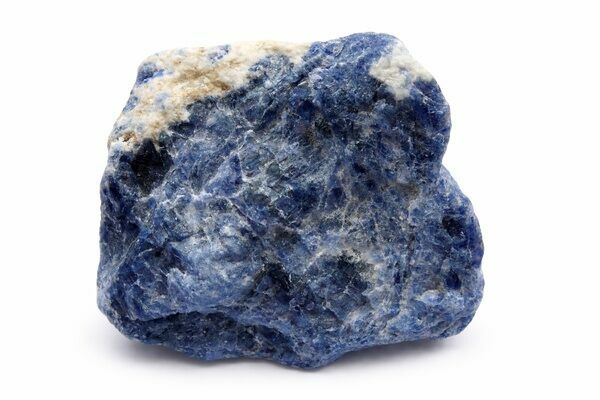
A section of raw sodalite
Humans eventually found practical use for sodalite too. While not an ore of any major industrial metal, it became an important source of sodium compounds in early chemistry and has since been used in pigments, glass additives, ornamental architecture, and metaphysical collections. Its modern appeal rests in its identity as a stone of collectors and makers—beautiful, abundant enough to enjoy, yet mineralogically distinctive enough to study.
Properties:
Chemical Class: Tectosilicate (Feldspathoid group)
Formula: Na₈(Al₆Si₆O₂₄)Cl₂
Hardness: 5.5–6 (Mohs)
Crystal System: Isometric (cubic)
Luster: Vitreous to greasy
Streak: White to pale blue
Density: 2.2–2.3 g/cm³
Cleavage: Poor to indistinct
Fracture: Conchoidal to uneven
Transparency: Transparent to opaque
Fluorescence: Orange-red (in hackmanite variety)
Special Optical Trait: Tenebrescence (hackmanite)
Common Associations: Nepheline, microcline, albite, calcite, cancrinite, apatite, aegirine
Sodalite forms in a very specific kind of molten rock—the opposite of the quartz-forming world most people know. Imagine magma deep underground as a thick, glowing soup of melted minerals. Most magmas are packed with silica, the ingredient needed to make quartz. But sodalite appears in magmas that are silica-poor and rich in sodium and aluminum instead. Because there isn’t enough silica to build quartz, other minerals take center stage, especially a rock called nepheline syenite—one of sodalite’s most important host rocks.
As this alkaline magma cools slowly in large underground chambers, minerals begin crystallizing like ice forming in a freezer. Sodalite doesn’t usually grow into sharp, standalone crystals. Instead, it forms later in the cooling process, filling the tiny leftover gaps between other minerals—almost like cement drying between bricks. Over time, those small crystal seeds merge into huge, solid blue masses, sometimes large enough to carve into spheres, bowls, or sculptures.
The mineral’s atomic structure acts like a microscopic cage, able to trap elements such as chlorine, which is essential to its chemistry. In some locations, sulfur sneaks into the cage too, creating hackmanite, a variety that can temporarily change color when exposed to sunlight before fading back again. The classic blue color of sodalite isn’t from a dye or impurity, but from tiny electrical interactions inside its structure—known as charge transfer—which can be intensified by traces of titanium or other elements, giving the stone its vivid, cloudy-sky-at-midnight aesthetic.
In simpler terms: sodalite forms in sodium-rich magmas that don’t have enough silica to make quartz. It grows in the cracks between earlier minerals, slowly locking itself into massive blue stone, with a structure that can trap extra elements that sometimes cause color-changing effects.
The world’s key sodalite localities read like chapters in a collector’s atlas:
Brazil (Bahia): The modern powerhouse source, producing massive deep-blue rough for carving and cutting.
Canada (Ontario, Bancroft): One of the earliest major commercial discoveries; iconic architectural use in Parliament.
Namibia: Darker blue tones with strong veining; popular for spheres and polished display.
Russia (Kola Peninsula): Occurs in complex alkaline intrusions with exotic mineral suites.
Greenland: Original discovery locality; more historical than commercial today.
India, USA (Arkansas, Maine), Pakistan: Smaller but notable lapidary and collector sources.
For most of the 1800s, sodalite lived a quiet, academic existence. After its identification in 1811, it was cataloged, studied, and admired under lamplight in mineralogy labs—not worn, traded, or carved. Unlike lapis lazuli, which built empires of commerce, sodalite built footnotes. Its name, rooted in sodium (“soda”), reflected a mineral that seemed engineered by chemistry itself—too cubic, too blue, too orderly to be anything but a scientific marvel. For decades it was something you labeled, not loved; a mineral you explained, not expressed.
That changed when Canada revealed sodalite deposits on a scale no one expected in 1891. Suddenly the stone had a second life, shifting from theoretical mineral to national symbol. The Parliament Buildings in Ottawa became its most prestigious stage, where sodalite panels and accents were installed not because the stone was rare, but because it was unapologetically Canadian—a homegrown blue worthy of civic pride. Jewelers and lapidaries near Bancroft soon followed the trend, cutting the stone into beads and cabochons, introducing sodalite to early 20th-century collectors who wanted a dramatic blue stone that wasn’t tied to aristocratic cost or ancient mystique.
Then Brazil rewrote the final chapter of sodalite’s commercial origin story. Beginning in the early 1900s, miners in Bahia uncovered sodalite in gigantic, uniform blue masses—blocks measured not in inches, but in tons. Brazil didn’t just supply sodalite to the world, it scaled it for the world. For the first time, the mineral was abundant enough to be carved into spheres, eggs, obelisks, bookends, tabletops, and architectural tiles. The market expanded from collectors to makers: artists shaped sodalite into polished forms, designers installed it into interiors, and jewelry studios embraced it as an accessible alternative to lapis that still carried cosmic visual drama.
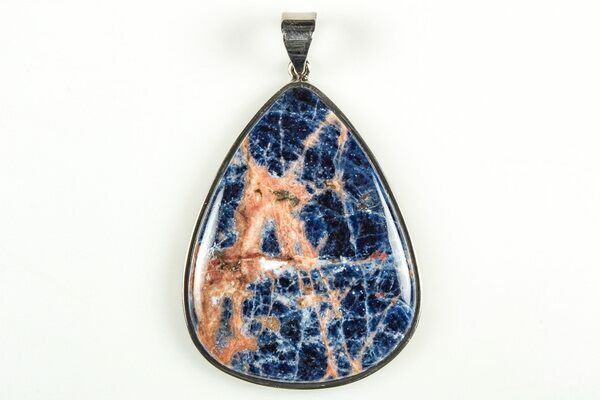
A pendant made out of polished Sodalite.
Sodalite’s appeal today comes from that dual identity it earned the hard way—a mineral of science that became a material of creativity. It is collected, cut, carved, polished, set into silver, drilled into beads, and stacked into stonework. It became a stone you could study and shape, admire and use. Whether glowing from a government hall, grounding a piece of jewelry, or spinning as a polished sphere in a collector’s hand, sodalite evolved from specimen to statement—proof that beauty doesn’t need antiquity to matter, only discovery big enough to share.

The mineral’s story begins officially in 1811 when it was first described in Greenland, but it remained largely a laboratory curiosity for decades. That changed dramatically in 1891 when vast deposits were discovered in Ontario, Canada, near Bancroft. Canadian sodalite was later propelled into the spotlight after being selected as a decorative stone for the interior of the Parliament Buildings in Ottawa. Its rise in popularity surged again in the early 1900s when massive quantities were uncovered in Brazil—deposits that would eventually supply global markets with carvable rough, polished slabs, spheres, and lapidary stone.
But sodalite’s origins are far older than its name. The conditions that form it are relatively uncommon. Unlike quartz, which thrives in silica-rich environments, sodalite crystallizes in silica-poor, alkaline igneous rocks, especially nepheline syenite, phonolite, and other feldspathoid-bearing formations. Deep underground, magma enriched with sodium, chlorine, and aluminum cools slowly enough for sodalite’s cage-like crystal lattice to assemble. In certain locations, sulfur can substitute into the structure, creating hackmanite, a tenebrescent variety that changes color when exposed to sunlight and slowly fades back when kept in darkness—a reversible “photochromic memory” stored in the crystal lattice.
Today, sodalite is mined across several continents, but the most famous sources still dominate conversations among collectors: Brazil, Canada, Namibia, and Russia. In Brazil’s Bahia region, sodalite forms in enormous blue masses sometimes weighing several tons, making it ideal for ornamental carvings. In Namibia and neighboring regions of southern Africa, the stone tends to show sharper contrast veining and a slightly darker blue tone. Russia’s sodalite, especially from the Kola Peninsula, is often associated with complex alkaline intrusions that also produce minerals like eudialyte and aegirine.
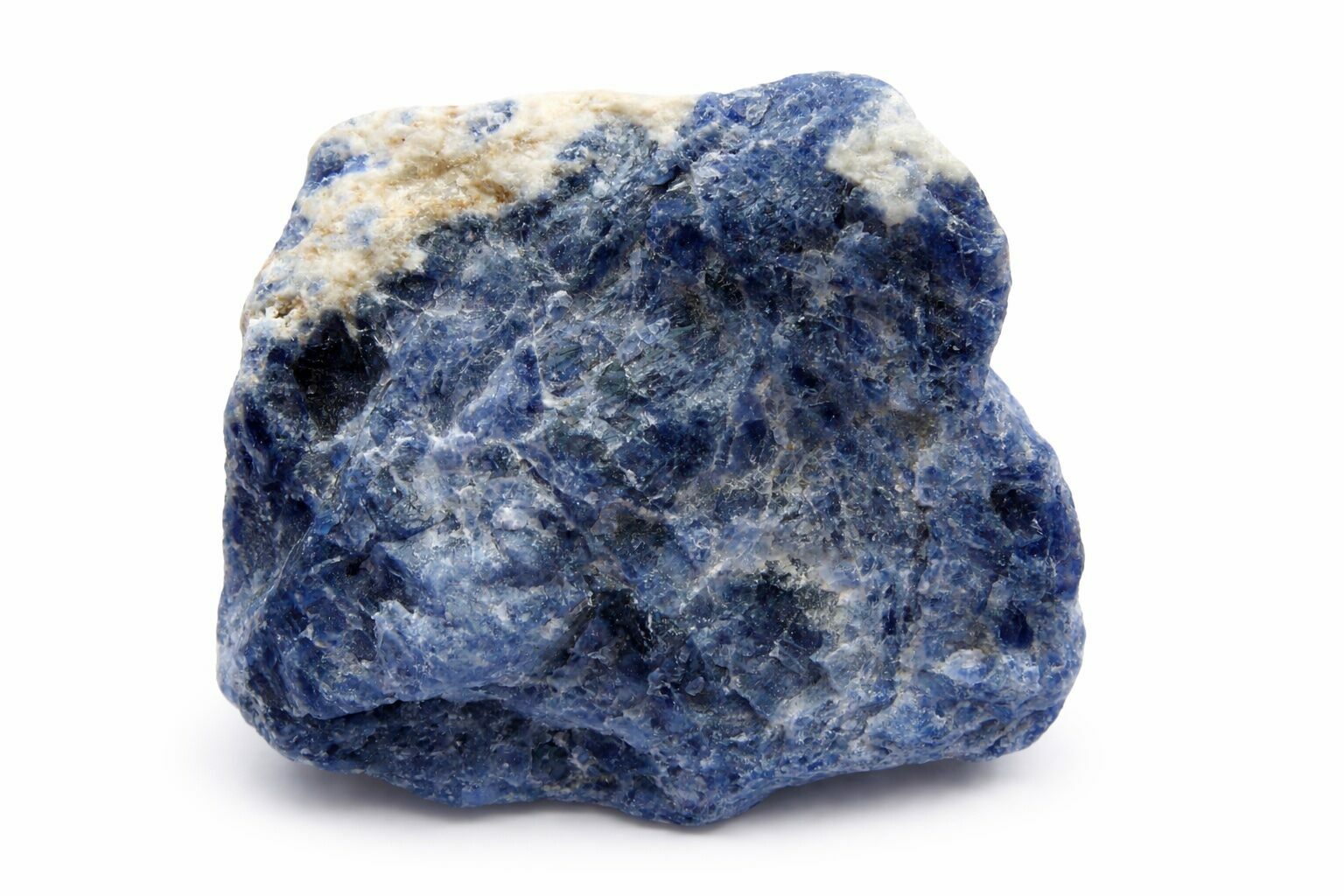
A section of raw sodalite
Humans eventually found practical use for sodalite too. While not an ore of any major industrial metal, it became an important source of sodium compounds in early chemistry and has since been used in pigments, glass additives, ornamental architecture, and metaphysical collections. Its modern appeal rests in its identity as a stone of collectors and makers—beautiful, abundant enough to enjoy, yet mineralogically distinctive enough to study.
Properties:
Chemical Class: Tectosilicate (Feldspathoid group)
Formula: Na₈(Al₆Si₆O₂₄)Cl₂
Hardness: 5.5–6 (Mohs)
Crystal System: Isometric (cubic)
Luster: Vitreous to greasy
Streak: White to pale blue
Density: 2.2–2.3 g/cm³
Cleavage: Poor to indistinct
Fracture: Conchoidal to uneven
Transparency: Transparent to opaque
Fluorescence: Orange-red (in hackmanite variety)
Special Optical Trait: Tenebrescence (hackmanite)
Common Associations: Nepheline, microcline, albite, calcite, cancrinite, apatite, aegirine
How It Forms
Sodalite forms in a very specific kind of molten rock—the opposite of the quartz-forming world most people know. Imagine magma deep underground as a thick, glowing soup of melted minerals. Most magmas are packed with silica, the ingredient needed to make quartz. But sodalite appears in magmas that are silica-poor and rich in sodium and aluminum instead. Because there isn’t enough silica to build quartz, other minerals take center stage, especially a rock called nepheline syenite—one of sodalite’s most important host rocks.
As this alkaline magma cools slowly in large underground chambers, minerals begin crystallizing like ice forming in a freezer. Sodalite doesn’t usually grow into sharp, standalone crystals. Instead, it forms later in the cooling process, filling the tiny leftover gaps between other minerals—almost like cement drying between bricks. Over time, those small crystal seeds merge into huge, solid blue masses, sometimes large enough to carve into spheres, bowls, or sculptures.
The mineral’s atomic structure acts like a microscopic cage, able to trap elements such as chlorine, which is essential to its chemistry. In some locations, sulfur sneaks into the cage too, creating hackmanite, a variety that can temporarily change color when exposed to sunlight before fading back again. The classic blue color of sodalite isn’t from a dye or impurity, but from tiny electrical interactions inside its structure—known as charge transfer—which can be intensified by traces of titanium or other elements, giving the stone its vivid, cloudy-sky-at-midnight aesthetic.
In simpler terms: sodalite forms in sodium-rich magmas that don’t have enough silica to make quartz. It grows in the cracks between earlier minerals, slowly locking itself into massive blue stone, with a structure that can trap extra elements that sometimes cause color-changing effects.
Where It Is Found
The world’s key sodalite localities read like chapters in a collector’s atlas:
Brazil (Bahia): The modern powerhouse source, producing massive deep-blue rough for carving and cutting.
Canada (Ontario, Bancroft): One of the earliest major commercial discoveries; iconic architectural use in Parliament.
Namibia: Darker blue tones with strong veining; popular for spheres and polished display.
Russia (Kola Peninsula): Occurs in complex alkaline intrusions with exotic mineral suites.
Greenland: Original discovery locality; more historical than commercial today.
India, USA (Arkansas, Maine), Pakistan: Smaller but notable lapidary and collector sources.
History, Uses & Appeal
For most of the 1800s, sodalite lived a quiet, academic existence. After its identification in 1811, it was cataloged, studied, and admired under lamplight in mineralogy labs—not worn, traded, or carved. Unlike lapis lazuli, which built empires of commerce, sodalite built footnotes. Its name, rooted in sodium (“soda”), reflected a mineral that seemed engineered by chemistry itself—too cubic, too blue, too orderly to be anything but a scientific marvel. For decades it was something you labeled, not loved; a mineral you explained, not expressed.
That changed when Canada revealed sodalite deposits on a scale no one expected in 1891. Suddenly the stone had a second life, shifting from theoretical mineral to national symbol. The Parliament Buildings in Ottawa became its most prestigious stage, where sodalite panels and accents were installed not because the stone was rare, but because it was unapologetically Canadian—a homegrown blue worthy of civic pride. Jewelers and lapidaries near Bancroft soon followed the trend, cutting the stone into beads and cabochons, introducing sodalite to early 20th-century collectors who wanted a dramatic blue stone that wasn’t tied to aristocratic cost or ancient mystique.
Then Brazil rewrote the final chapter of sodalite’s commercial origin story. Beginning in the early 1900s, miners in Bahia uncovered sodalite in gigantic, uniform blue masses—blocks measured not in inches, but in tons. Brazil didn’t just supply sodalite to the world, it scaled it for the world. For the first time, the mineral was abundant enough to be carved into spheres, eggs, obelisks, bookends, tabletops, and architectural tiles. The market expanded from collectors to makers: artists shaped sodalite into polished forms, designers installed it into interiors, and jewelry studios embraced it as an accessible alternative to lapis that still carried cosmic visual drama.
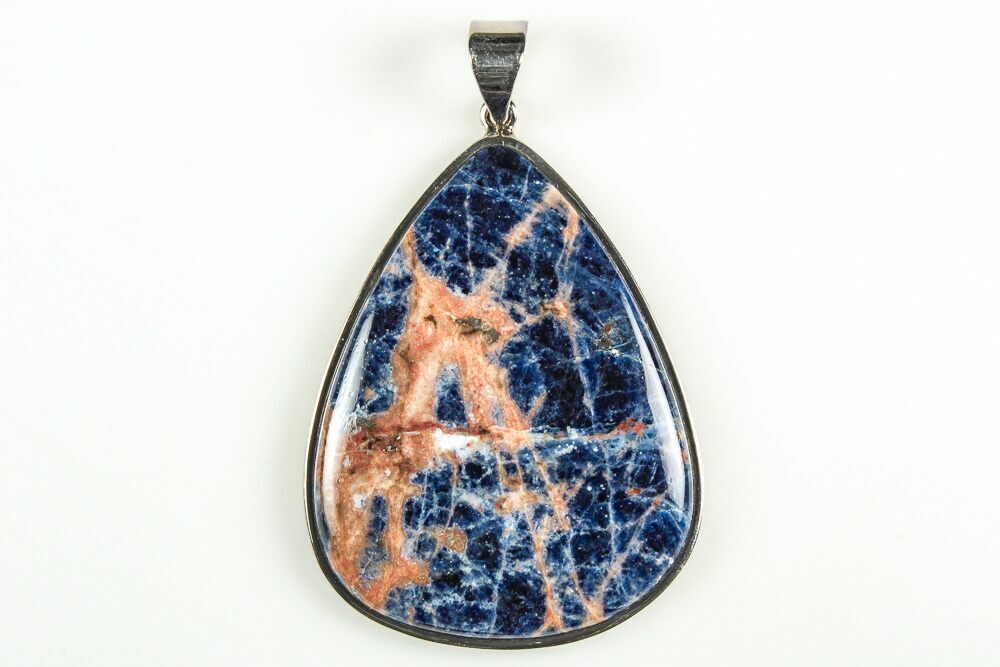
A pendant made out of polished Sodalite.
Sodalite’s appeal today comes from that dual identity it earned the hard way—a mineral of science that became a material of creativity. It is collected, cut, carved, polished, set into silver, drilled into beads, and stacked into stonework. It became a stone you could study and shape, admire and use. Whether glowing from a government hall, grounding a piece of jewelry, or spinning as a polished sphere in a collector’s hand, sodalite evolved from specimen to statement—proof that beauty doesn’t need antiquity to matter, only discovery big enough to share.


