 Reviews

Vivianite: Earth’s Real-Life “kryptonite” Crystal
There are some minerals that feel like they belong in a museum case—beautiful, sure, but familiar. Vivianite is different. Vivianite feels like something you’re not quite supposed to find, like a crystal pulled from a forgotten corner of the Earth where strange chemistry and ancient time have been quietly at work. In fact, few minerals inspire the same immediate reaction the first time you see a good specimen: a deep, glowing blue-green crystal that looks uncannily like a shard of real-life kryptonite.
It’s the color that does it. That vivid, electric mix of green and blue can seem almost unreal, especially when vivianite forms in sharp blades or prismatic clusters. Under the right light, the crystals can look like they’re lit from within—otherworldly, sci-fi, and just a little bit magical. It’s easy to imagine a piece of vivianite tucked into the Fortress of Solitude, or sitting in a cinematic close-up as some mysterious alien mineral. Yet vivianite isn’t fictional at all. It’s one of nature’s most fascinating reminders that the planet can produce colors and forms every bit as strange as anything dreamed up in comics.
What makes vivianite even more captivating is that it doesn’t always start out looking like kryptonite. Freshly formed vivianite can be surprisingly pale—sometimes nearly colorless, sometimes a soft green. But once it is exposed to air and light, something remarkable happens: the mineral begins to darken, slowly shifting into richer shades of teal, blue-green, and deep ocean blue. Collectors often describe it as a mineral that “wakes up” after being found, revealing its true personality only after it leaves the darkness of the ground.
That transformation gives vivianite a sense of life and motion that most minerals don’t have. A quartz crystal looks the same today as it will in a thousand years. Vivianite feels more like a moment captured in crystal form—beautiful, but fleeting, and still subtly changing. In a way, owning a vivianite specimen is like owning a living photograph of the chemical conditions that created it.
And those conditions are part of the story. Vivianite forms in quiet, hidden places where oxygen is scarce—waterlogged clays, peat bogs, muddy sediments, and even sealed pockets inside rocks. These are environments where time slows down, where organic material can linger, and where minerals can grow in unusual ways. Vivianite is often born in the company of decay and preservation: places rich in iron, moisture, and the chemical leftovers of once-living things.
That’s why vivianite has such an eerie and beautiful connection to fossils. Few minerals are so closely tied to the remains of ancient life. Vivianite can appear inside fossil shells, along cracks in fossil bone, or as sparkling crystal growths that seem to decorate relics of prehistoric worlds. It’s as if the mineral is nature’s way of turning the chemistry of life—bones, tissues, buried organisms—into something luminous and crystalline.
For fossil collectors, that makes vivianite especially thrilling. Imagine splitting open a nodule or lifting a fossil from clay, only to find deep blue-green crystals tucked inside like a secret. The fossil tells the story of life long gone; vivianite tells the story of what happened afterward, in the slow mineral-rich darkness underground.
Despite its striking beauty, vivianite remains something of a hidden gem in the mineral world. It is softer and more delicate than many collector favorites, and its sensitivity to light means it must be stored with care. But that fragility is part of its charm. Vivianite isn’t just another crystal—it’s a mineral with mood, mystery, and transformation built into its very nature.
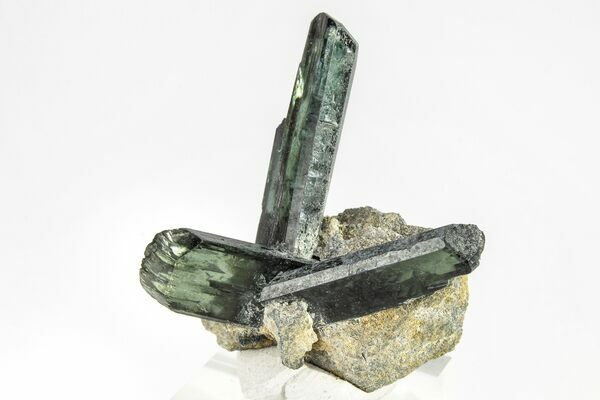
A cluster of gorgeous emerald-green vivianite crystals, collected from the Roșia Poieni Mine in Alba County, Romania.
In the end, vivianite is one of Earth’s closest answers to a fantasy mineral: a glowing blue-green treasure that forms in the shadows, often alongside fossils, and changes as soon as it meets the light. If kryptonite existed in nature, it might look exactly like this.
Chemical formula: Fe₃(PO₄)₂·8H₂O (hydrated iron(II) phosphate)
Mineral class: Phosphate
Crystal system: Monoclinic
Typical habit: Prismatic to flattened crystals; also nodules, crusts, earthy masses
Color: Colorless to pale green when fresh; deep blue to blue-green as it oxidizes
Luster: Vitreous to pearly; can become dull with alteration
Hardness (Mohs): ~1½–2
Specific gravity: ~2.67–2.69
Notable behavior: Readily oxidizes; can alter to metavivianite; color can change rapidly under light
Commonly associated minerals: goethite/limonite, pyrite, marcasite, siderite, barite, other iron phosphates
Vivianite is fundamentally a chemistry-of-place mineral: it forms where iron(II) and phosphate can coexist in water without immediately being destroyed by oxygen. The key is a reducing environment—one that limits available O₂—so iron stays in the ferrous state (Fe²⁺). Phosphate may come from multiple sources, but some of the most effective are biological: decaying organic matter, bone, teeth, shells, guano-rich sediments, or any phosphorus-bearing material that releases phosphate into pore waters.
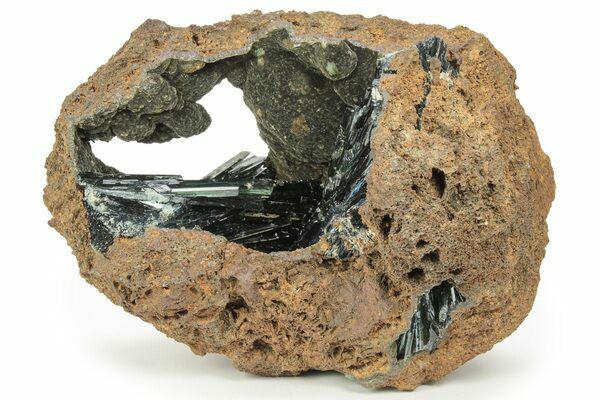
Emerald-green vivianite crystals in phosphatic nodule< from Brazil.
In sedimentary and near-surface settings, vivianite often precipitates in waterlogged clays, peat bogs, and organic-rich muds, sometimes within “micro-environments” that are chemically distinct from the surrounding sediment (for example, around a decaying shell or within a nodule). In ore environments, it can occur as a secondary mineral in oxidized zones or weathering products where phosphate-bearing fluids circulate and local redox conditions still allow Fe²⁺ to persist long enough for vivianite to crystallize.
Once exposed to air and light, vivianite tends to oxidize internally—Fe²⁺ partially converts to Fe³⁺—driving the familiar deepening of blue-green color and, in some cases, a progression toward metavivianite.
Vivianite has one of the most fascinating fossil connections of any mineral, because it so often forms not just near fossils, but because of them. While many minerals are accidental companions to prehistoric remains, vivianite is frequently a direct chemical echo of once-living organisms. It is, quite literally, a mineral born from the leftovers of life.
One of the most common and striking examples is vivianite forming inside fossil shells. Fossil bivalves and gastropods buried in clay-rich sediments can create tiny sealed chambers where water, iron, and phosphorus interact over long periods of time. In these enclosed spaces, vivianite may grow as delicate blue-green crystals lining the interior of the shell, almost like a hidden geode. Collectors have found vivianite tucked inside ancient marine shells in sedimentary deposits where oxygen was scarce and the chemistry remained stable enough for crystals to develop.
Vivianite is also well known for forming in association with fossil bone, which provides an especially rich source of phosphorus. Bones are naturally phosphate-heavy, and as they slowly break down underground, they can release the ingredients needed for vivianite to form. In low-oxygen environments—such as waterlogged sediments, bogs, or fine clay deposits—vivianite may crystallize along cracks in fossilized bone or even replace portions of it. This creates an extraordinary visual: the dark, ancient structure of bone accented with luminous blue-green mineral growth.
A famous and dramatic example of vivianite’s fossil association comes from one of the most iconic Pleistocene discoveries in North America: “Blue Babe.” Blue Babe is the nickname given to a remarkably preserved steppe bison (Bison priscus) discovered in Alaska in 1979. What made the specimen so visually unforgettable was its intense bluish coloration—caused not by paint or staining, but by vivianite forming within and around the fossil remains during burial. The mineral developed as the bison’s body lay in cold, oxygen-poor ground, where iron and phosphorus combined over time. Vivianite essentially “painted” the fossil in natural blue tones, turning the specimen into one of the most famous examples of mineralization linked directly to ancient life.
Discovery & naming (early 1800s). Vivianite was formally named in 1817 by Abraham Gottlob Werner, one of the most influential figures in early mineral classification. The mineral is tied to Cornwall, England, with discovery at Wheal Kind (St Agnes). Werner named it to honor John Henry Vivian (1785–1855), associated with Truro and mining circles—an acknowledgment rooted in the era when mines were both industrial engines and natural history laboratories.
A mineral that “turns on” after collection. Long before modern spectroscopy explained oxidation states, vivianite must have seemed almost alive: pulled from the ground pale or greenish, then darkening into richer blues as it dried and met the air. This property helped make vivianite memorable in museum collections and private cabinets—yet also made it tricky, because its appearance could drift over time. Today, that same behavior is understood as an internal oxidation sequence that can proceed under visible light and may ultimately yield related phases (like metavivianite) while preserving crystal form.
Pigment and “blue ochre.” Vivianite has also had a quiet artistic career. As a pigment, it’s often referred to as “blue ochre.” Historical accounts describe its use from antiquity onward and in certain European wall-painting traditions (including medieval contexts), though it never became as universally dominant as ultramarine, azurite, or later synthetic blues—partly because the material can be variable and chemically sensitive.
Scientific and environmental interest. In modern research, vivianite matters beyond collecting: it plays a role in understanding how phosphorus is stored and cycled in anoxic sediments (lakes, wetlands, and some marine settings). Its formation can lock phosphate into a stable mineral form, influencing nutrient availability and long-term geochemistry. (This is one reason vivianite shows up frequently in sediment and diagenesis discussions.)
Why it remains a collector’s mineral. Vivianite’s place in the hobby is anchored by two things: (1) the sheer beauty of well-formed crystals—especially deep blue-green prisms in vugs—and (2) the “story on the label,” because many specimens come from geologically or historically evocative settings: bog deposits, iron ore basins, classic European mines, and fossil-bearing sediments. Its softness and tendency to change only add to the sense that you’re caring for something delicate and rare in spirit, even when the species itself is not vanishingly uncommon.
Vivianite may form in quiet, oxygen-poor environments around the world, but only a handful of localities have produced specimens that truly captivate collectors. From iron-rich sedimentary basins to historic European mines and South American ore deposits, these sites have yielded crystals prized for their size, color saturation, and aesthetic presentation. Some are known for inky, nearly black-blue blades that glow under light; others for sharp, transparent prismatic crystals perched dramatically on contrasting matrix. Together, these localities define what serious collectors think of when they picture exceptional vivianite—and they tell the broader story of the unique geologic conditions required to grow Earth’s most “kryptonite-like” mineral.
The Kerch Peninsula is legendary among collectors for dark, saturated blue-green vivianite crystals—often spear-like or prismatic—lining cavities in iron-rich host material. Specimens can look almost black in low light and then flash blue-green when illuminated, a dramatic effect that makes Kerch vivianite instantly recognizable in display cases. This locality is closely tied to an iron-ore basin setting, and associated iron oxides/hydroxides (goethite/limonite) commonly appear alongside vivianite, reflecting the iron-dominant environment in which the crystals formed.
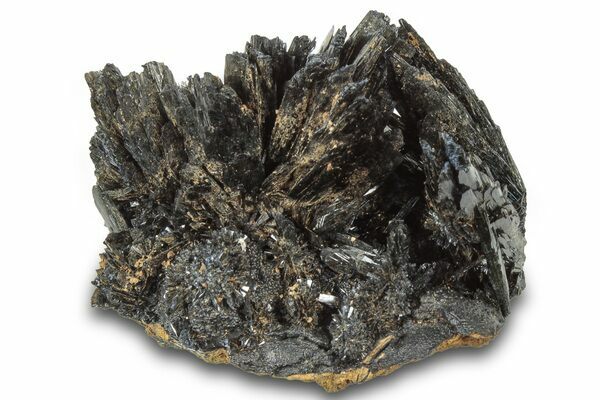
Dark-green vivianite crystals from the Kerchenskoe Mine, Crimea, Ukraine
Bolivia’s Llallagua district—especially the famed Siglo XX Mine—is a cornerstone locality for high-quality vivianite: large, well-formed prismatic crystals, sometimes reaching impressive sizes, prized for their color and form. Collectors often seek Bolivian pieces for better transparency and strong blue-green tones, and the specimens may appear on iron-oxide matrices that reflect complex sulfide-ore alteration histories. Bolivia has produced standout vivianite for decades, and the locality remains one of the most cited for serious mineral cabinets.
Brazil’s Cigana Mine in Minas Gerais is known for attractive vivianite crystals that can be wedge-shaped and aesthetically presented on matrix, sometimes with bright mica (muscovite) and sparkling pyrite microcrystals providing contrast. Pieces from this region can show a smoky blue coloration and a pleasing combination of crystal sharpness and matrix “sparkle,” which is part of why Minas Gerais localities remain perennial favorites among collectors—vivianite included.
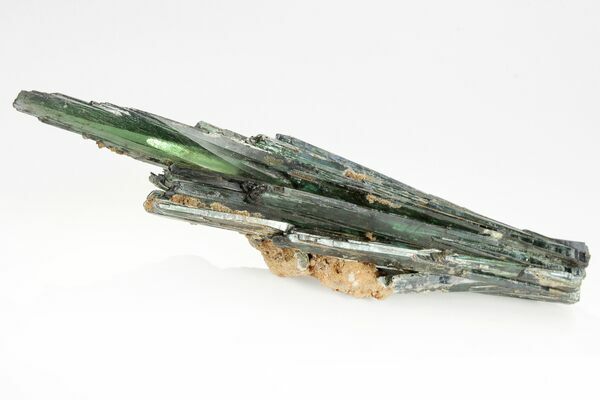
Gemmy, blue-green vivianite crystals from the Cigana Mine in Brazil.
Cameroon is famous in collector lore for producing exceptionally large vivianite crystals, including reported specimens on the order of meter-scale from muddy, sedimentary environments. These occurrences highlight vivianite’s comfort zone: water-rich, low-oxygen settings where iron and phosphate can combine and crystals can grow without being immediately destabilized by oxidation. While such giant pieces are not common on the general market, the locality underscores that vivianite can grow to startling dimensions when chemistry and time cooperate.
Cornwall matters not just as a place to find vivianite, but as the species’ historical anchor. Wheal Kind (St Agnes) is tied to the early identification of vivianite and the naming in 1817. For collectors, type-locality material often carries a special aura—even when specimens are modest—because it connects the mineral to the moment it entered the scientific record and to the early 19th-century world of mines, mineral cabinets, and the birth of modern geological classification.

It’s the color that does it. That vivid, electric mix of green and blue can seem almost unreal, especially when vivianite forms in sharp blades or prismatic clusters. Under the right light, the crystals can look like they’re lit from within—otherworldly, sci-fi, and just a little bit magical. It’s easy to imagine a piece of vivianite tucked into the Fortress of Solitude, or sitting in a cinematic close-up as some mysterious alien mineral. Yet vivianite isn’t fictional at all. It’s one of nature’s most fascinating reminders that the planet can produce colors and forms every bit as strange as anything dreamed up in comics.
What makes vivianite even more captivating is that it doesn’t always start out looking like kryptonite. Freshly formed vivianite can be surprisingly pale—sometimes nearly colorless, sometimes a soft green. But once it is exposed to air and light, something remarkable happens: the mineral begins to darken, slowly shifting into richer shades of teal, blue-green, and deep ocean blue. Collectors often describe it as a mineral that “wakes up” after being found, revealing its true personality only after it leaves the darkness of the ground.
That transformation gives vivianite a sense of life and motion that most minerals don’t have. A quartz crystal looks the same today as it will in a thousand years. Vivianite feels more like a moment captured in crystal form—beautiful, but fleeting, and still subtly changing. In a way, owning a vivianite specimen is like owning a living photograph of the chemical conditions that created it.
And those conditions are part of the story. Vivianite forms in quiet, hidden places where oxygen is scarce—waterlogged clays, peat bogs, muddy sediments, and even sealed pockets inside rocks. These are environments where time slows down, where organic material can linger, and where minerals can grow in unusual ways. Vivianite is often born in the company of decay and preservation: places rich in iron, moisture, and the chemical leftovers of once-living things.
That’s why vivianite has such an eerie and beautiful connection to fossils. Few minerals are so closely tied to the remains of ancient life. Vivianite can appear inside fossil shells, along cracks in fossil bone, or as sparkling crystal growths that seem to decorate relics of prehistoric worlds. It’s as if the mineral is nature’s way of turning the chemistry of life—bones, tissues, buried organisms—into something luminous and crystalline.
For fossil collectors, that makes vivianite especially thrilling. Imagine splitting open a nodule or lifting a fossil from clay, only to find deep blue-green crystals tucked inside like a secret. The fossil tells the story of life long gone; vivianite tells the story of what happened afterward, in the slow mineral-rich darkness underground.
Despite its striking beauty, vivianite remains something of a hidden gem in the mineral world. It is softer and more delicate than many collector favorites, and its sensitivity to light means it must be stored with care. But that fragility is part of its charm. Vivianite isn’t just another crystal—it’s a mineral with mood, mystery, and transformation built into its very nature.
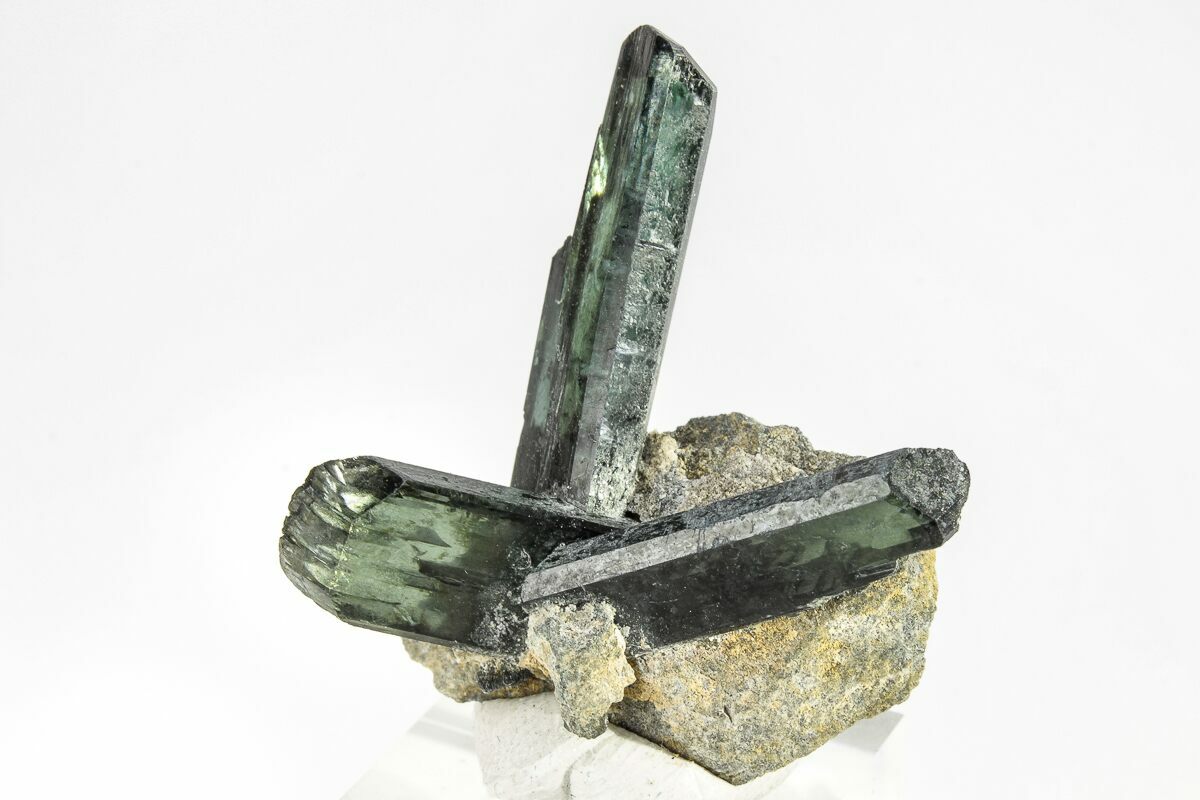
A cluster of gorgeous emerald-green vivianite crystals, collected from the Roșia Poieni Mine in Alba County, Romania.
In the end, vivianite is one of Earth’s closest answers to a fantasy mineral: a glowing blue-green treasure that forms in the shadows, often alongside fossils, and changes as soon as it meets the light. If kryptonite existed in nature, it might look exactly like this.
Key Properties
How Vivianite Forms
Vivianite is fundamentally a chemistry-of-place mineral: it forms where iron(II) and phosphate can coexist in water without immediately being destroyed by oxygen. The key is a reducing environment—one that limits available O₂—so iron stays in the ferrous state (Fe²⁺). Phosphate may come from multiple sources, but some of the most effective are biological: decaying organic matter, bone, teeth, shells, guano-rich sediments, or any phosphorus-bearing material that releases phosphate into pore waters.
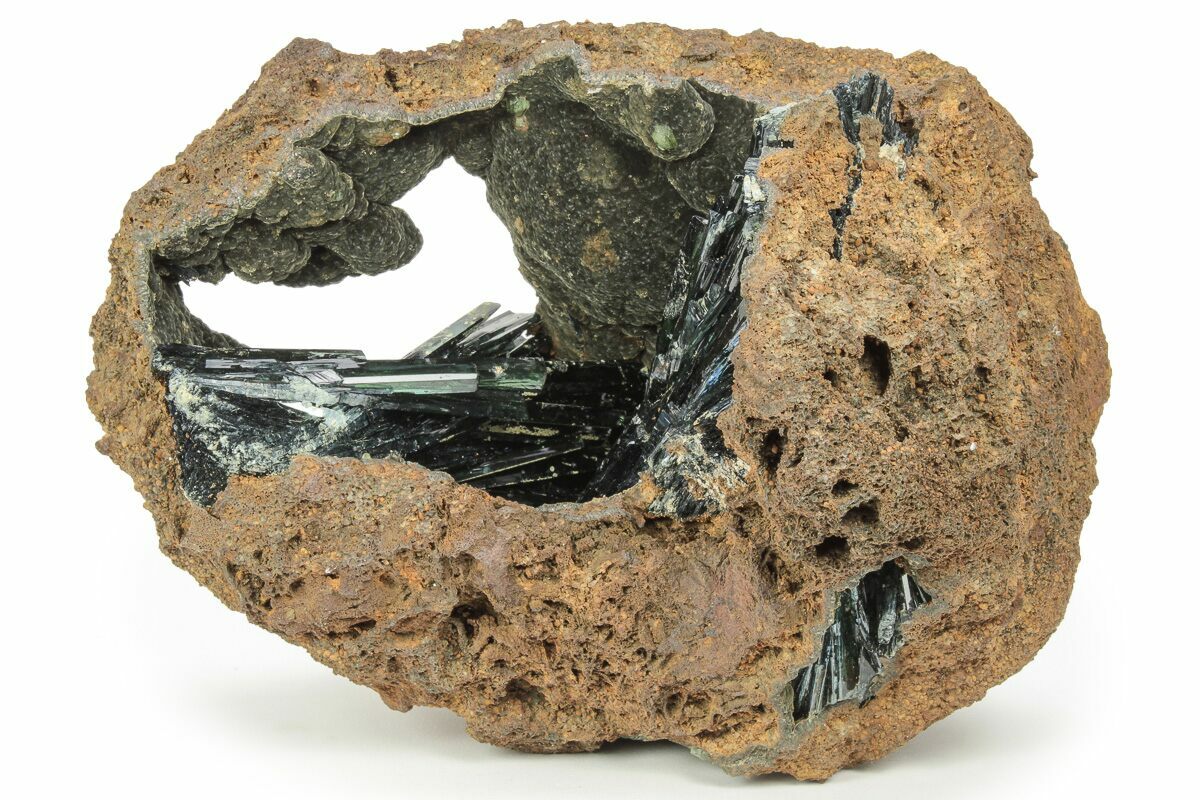
Emerald-green vivianite crystals in phosphatic nodule< from Brazil.
In sedimentary and near-surface settings, vivianite often precipitates in waterlogged clays, peat bogs, and organic-rich muds, sometimes within “micro-environments” that are chemically distinct from the surrounding sediment (for example, around a decaying shell or within a nodule). In ore environments, it can occur as a secondary mineral in oxidized zones or weathering products where phosphate-bearing fluids circulate and local redox conditions still allow Fe²⁺ to persist long enough for vivianite to crystallize.
Once exposed to air and light, vivianite tends to oxidize internally—Fe²⁺ partially converts to Fe³⁺—driving the familiar deepening of blue-green color and, in some cases, a progression toward metavivianite.
Vivianite & Fossils
Vivianite has one of the most fascinating fossil connections of any mineral, because it so often forms not just near fossils, but because of them. While many minerals are accidental companions to prehistoric remains, vivianite is frequently a direct chemical echo of once-living organisms. It is, quite literally, a mineral born from the leftovers of life.
One of the most common and striking examples is vivianite forming inside fossil shells. Fossil bivalves and gastropods buried in clay-rich sediments can create tiny sealed chambers where water, iron, and phosphorus interact over long periods of time. In these enclosed spaces, vivianite may grow as delicate blue-green crystals lining the interior of the shell, almost like a hidden geode. Collectors have found vivianite tucked inside ancient marine shells in sedimentary deposits where oxygen was scarce and the chemistry remained stable enough for crystals to develop.
Vivianite is also well known for forming in association with fossil bone, which provides an especially rich source of phosphorus. Bones are naturally phosphate-heavy, and as they slowly break down underground, they can release the ingredients needed for vivianite to form. In low-oxygen environments—such as waterlogged sediments, bogs, or fine clay deposits—vivianite may crystallize along cracks in fossilized bone or even replace portions of it. This creates an extraordinary visual: the dark, ancient structure of bone accented with luminous blue-green mineral growth.
A famous and dramatic example of vivianite’s fossil association comes from one of the most iconic Pleistocene discoveries in North America: “Blue Babe.” Blue Babe is the nickname given to a remarkably preserved steppe bison (Bison priscus) discovered in Alaska in 1979. What made the specimen so visually unforgettable was its intense bluish coloration—caused not by paint or staining, but by vivianite forming within and around the fossil remains during burial. The mineral developed as the bison’s body lay in cold, oxygen-poor ground, where iron and phosphorus combined over time. Vivianite essentially “painted” the fossil in natural blue tones, turning the specimen into one of the most famous examples of mineralization linked directly to ancient life.
History & Uses
Discovery & naming (early 1800s). Vivianite was formally named in 1817 by Abraham Gottlob Werner, one of the most influential figures in early mineral classification. The mineral is tied to Cornwall, England, with discovery at Wheal Kind (St Agnes). Werner named it to honor John Henry Vivian (1785–1855), associated with Truro and mining circles—an acknowledgment rooted in the era when mines were both industrial engines and natural history laboratories.
A mineral that “turns on” after collection. Long before modern spectroscopy explained oxidation states, vivianite must have seemed almost alive: pulled from the ground pale or greenish, then darkening into richer blues as it dried and met the air. This property helped make vivianite memorable in museum collections and private cabinets—yet also made it tricky, because its appearance could drift over time. Today, that same behavior is understood as an internal oxidation sequence that can proceed under visible light and may ultimately yield related phases (like metavivianite) while preserving crystal form.
Pigment and “blue ochre.” Vivianite has also had a quiet artistic career. As a pigment, it’s often referred to as “blue ochre.” Historical accounts describe its use from antiquity onward and in certain European wall-painting traditions (including medieval contexts), though it never became as universally dominant as ultramarine, azurite, or later synthetic blues—partly because the material can be variable and chemically sensitive.
Scientific and environmental interest. In modern research, vivianite matters beyond collecting: it plays a role in understanding how phosphorus is stored and cycled in anoxic sediments (lakes, wetlands, and some marine settings). Its formation can lock phosphate into a stable mineral form, influencing nutrient availability and long-term geochemistry. (This is one reason vivianite shows up frequently in sediment and diagenesis discussions.)
Why it remains a collector’s mineral. Vivianite’s place in the hobby is anchored by two things: (1) the sheer beauty of well-formed crystals—especially deep blue-green prisms in vugs—and (2) the “story on the label,” because many specimens come from geologically or historically evocative settings: bog deposits, iron ore basins, classic European mines, and fossil-bearing sediments. Its softness and tendency to change only add to the sense that you’re caring for something delicate and rare in spirit, even when the species itself is not vanishingly uncommon.
Key Collecting Localities
Vivianite may form in quiet, oxygen-poor environments around the world, but only a handful of localities have produced specimens that truly captivate collectors. From iron-rich sedimentary basins to historic European mines and South American ore deposits, these sites have yielded crystals prized for their size, color saturation, and aesthetic presentation. Some are known for inky, nearly black-blue blades that glow under light; others for sharp, transparent prismatic crystals perched dramatically on contrasting matrix. Together, these localities define what serious collectors think of when they picture exceptional vivianite—and they tell the broader story of the unique geologic conditions required to grow Earth’s most “kryptonite-like” mineral.
Kerch Peninsula (Crimea / Kerch iron-ore basin region)
The Kerch Peninsula is legendary among collectors for dark, saturated blue-green vivianite crystals—often spear-like or prismatic—lining cavities in iron-rich host material. Specimens can look almost black in low light and then flash blue-green when illuminated, a dramatic effect that makes Kerch vivianite instantly recognizable in display cases. This locality is closely tied to an iron-ore basin setting, and associated iron oxides/hydroxides (goethite/limonite) commonly appear alongside vivianite, reflecting the iron-dominant environment in which the crystals formed.
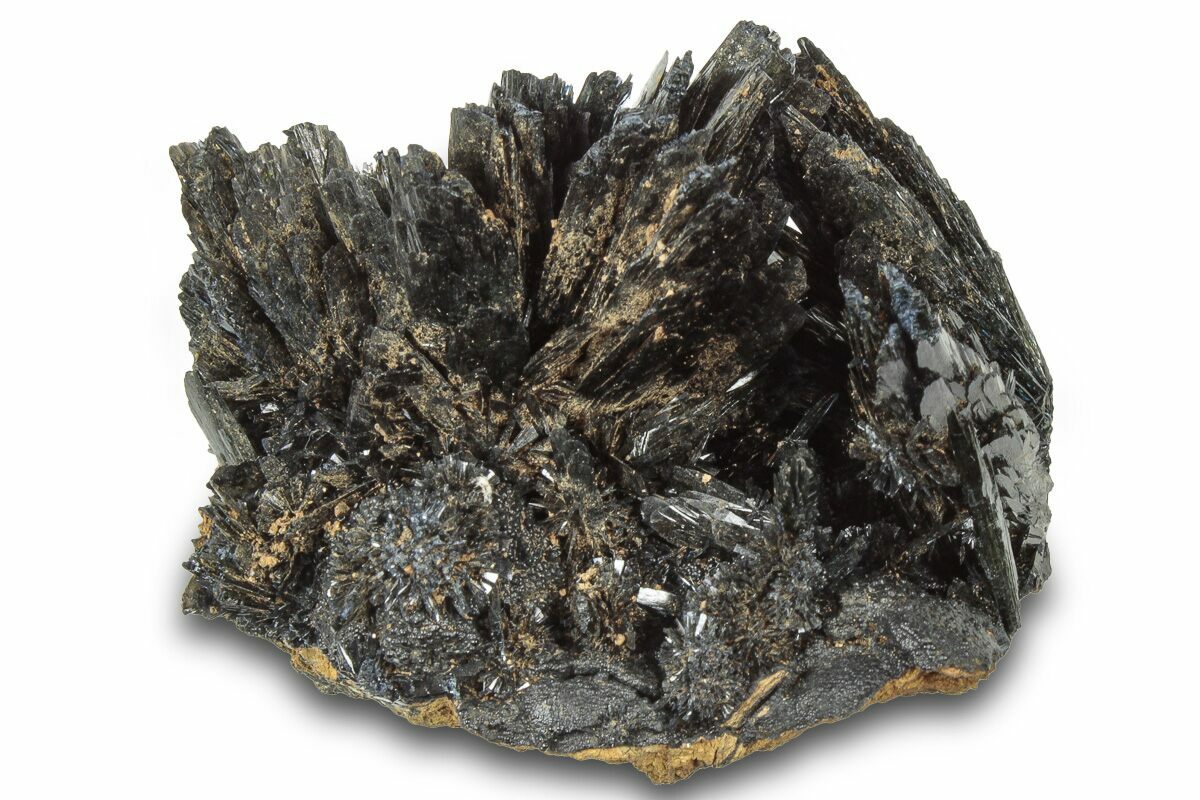
Dark-green vivianite crystals from the Kerchenskoe Mine, Crimea, Ukraine
Llallagua / Siglo XX Mine (Potosí, Bolivia)
Bolivia’s Llallagua district—especially the famed Siglo XX Mine—is a cornerstone locality for high-quality vivianite: large, well-formed prismatic crystals, sometimes reaching impressive sizes, prized for their color and form. Collectors often seek Bolivian pieces for better transparency and strong blue-green tones, and the specimens may appear on iron-oxide matrices that reflect complex sulfide-ore alteration histories. Bolivia has produced standout vivianite for decades, and the locality remains one of the most cited for serious mineral cabinets.
Cigana Mine, Galileia, Minas Gerais (Brazil)
Brazil’s Cigana Mine in Minas Gerais is known for attractive vivianite crystals that can be wedge-shaped and aesthetically presented on matrix, sometimes with bright mica (muscovite) and sparkling pyrite microcrystals providing contrast. Pieces from this region can show a smoky blue coloration and a pleasing combination of crystal sharpness and matrix “sparkle,” which is part of why Minas Gerais localities remain perennial favorites among collectors—vivianite included.
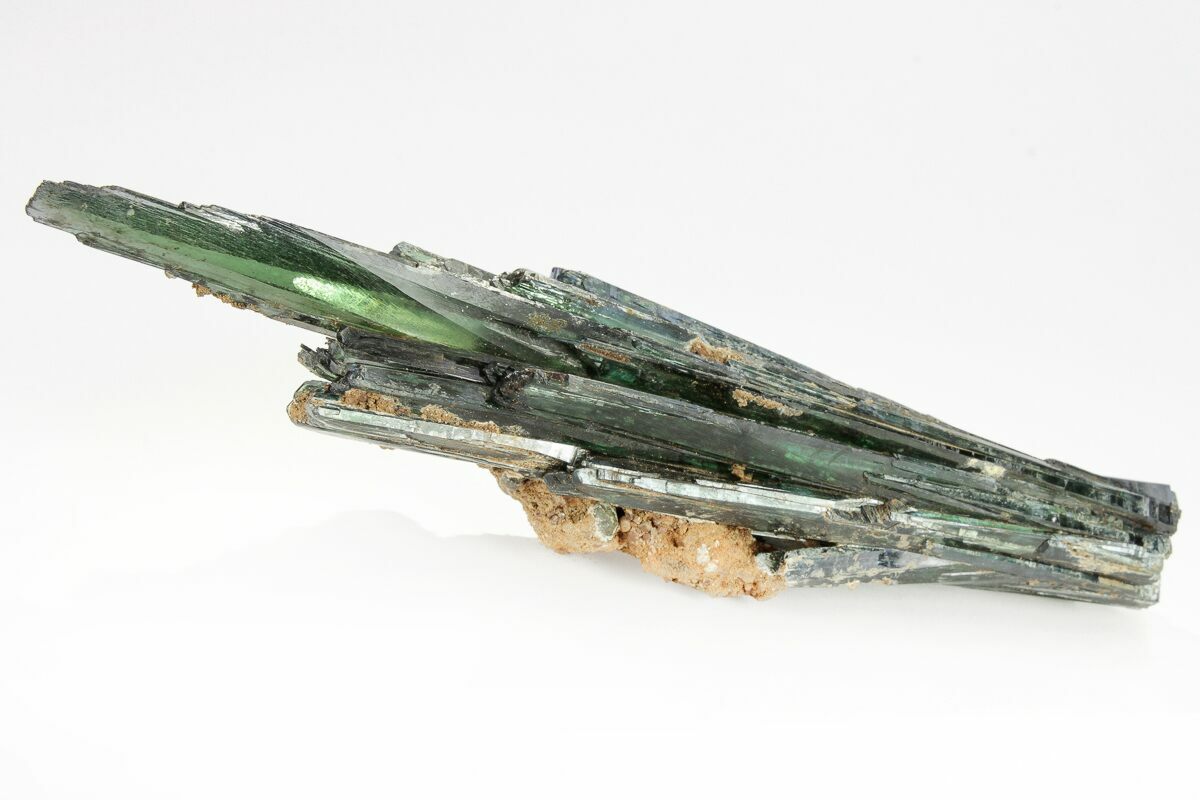
Gemmy, blue-green vivianite crystals from the Cigana Mine in Brazil.
Cameroon (large-crystal occurrences in mud/sediment)
Cameroon is famous in collector lore for producing exceptionally large vivianite crystals, including reported specimens on the order of meter-scale from muddy, sedimentary environments. These occurrences highlight vivianite’s comfort zone: water-rich, low-oxygen settings where iron and phosphate can combine and crystals can grow without being immediately destabilized by oxidation. While such giant pieces are not common on the general market, the locality underscores that vivianite can grow to startling dimensions when chemistry and time cooperate.
Cornwall, England (Wheal Kind, St Agnes) — the type locality story
Cornwall matters not just as a place to find vivianite, but as the species’ historical anchor. Wheal Kind (St Agnes) is tied to the early identification of vivianite and the naming in 1817. For collectors, type-locality material often carries a special aura—even when specimens are modest—because it connects the mineral to the moment it entered the scientific record and to the early 19th-century world of mines, mineral cabinets, and the birth of modern geological classification.


