 Reviews

Larimar: The Gemstone of the Caribbean Sea
There are gemstones that dazzle with fire, others that glow with depth, and a rare few that seem to hold an entire landscape within them. Larimar belongs to that last category. At first glance, it looks less like a mineral and more like a fragment of tropical ocean—soft blue, streaked with white, like sunlight dancing through shallow Caribbean water over rippled sand. It is a gemstone so geographically restricted that it is found in only one place on Earth: the Dominican Republic. Nowhere else.
Larimar is the blue variety of the mineral pectolite, a mineral that is typically white or gray and found in many parts of the world. But in a remarkable geological twist, trace amounts of copper within the Dominican material transform ordinary pectolite into something extraordinary—coloring it in hues that range from pale sky blue to deep volcanic blue. The most prized pieces resemble swirling ocean currents, complete with cloud-like white patterns caused by fibrous crystal structures.
Unlike many famous gemstones, larimar is a relative newcomer to the world stage. It was only officially rediscovered in 1974, making it younger in commercial history than many of the jewelry pieces crafted from it. Yet locals had known of blue stones washing down rivers for decades before its formal identification. The stone’s name itself is deeply personal—combining “Larissa,” the daughter of its rediscoverer, with “mar,” the Spanish word for sea.
Larimar’s volcanic origins add another layer of intrigue. It forms within cavities of ancient basaltic lava flows, born from hydrothermal activity associated with Caribbean volcanism millions of years ago. In some cases, it even replaces fossilized wood—creating rare specimens where ancient tree structures are preserved in shades of tropical blue.
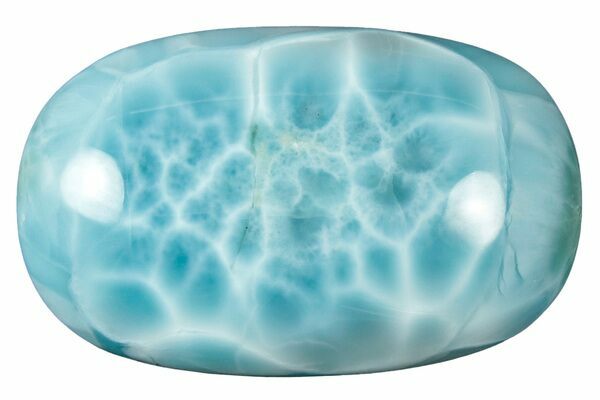
A polished Larimar cabochon displaying the color and patterning of gem-grade material.
Its rarity, singular origin, and unmistakable color have made larimar one of the most distinctive gemstones in the world. Often called the “Dolphin Stone,” the “Atlantis Stone,” or the “Caribbean Gem”, larimar carries with it a sense of place unlike almost any other mineral. It is not merely a stone—it is geology, history, and ocean all captured in crystal form.
Mineral Group: Silicate
Mineral Species: Pectolite (blue variety)
Chemical Formula: NaCa₂Si₃O₈(OH)
Color: White, light blue, sky blue, turquoise blue, deep blue
Color Cause: Trace amounts of copper
Crystal System: Triclinic
Crystal Habit: Fibrous, radiating, massive
Luster: Silky to vitreous
Transparency: Translucent to opaque
Hardness: 4.5–5 on the Mohs scale
Specific Gravity: ~2.7–2.9
Streak: White
Larimar’s formation is tied directly to volcanic activity in the Caribbean region. Millions of years ago, during the Miocene epoch, volcanic eruptions in what is now the southwestern Dominican Republic produced thick basaltic lava flows. As these lavas cooled, cavities and fractures developed within the rock.
Hydrothermal fluids—hot, mineral-rich waters—circulated through these volcanic rocks. These fluids carried dissolved elements including sodium, calcium, silica, and crucially, copper. Under the right temperature and pressure conditions, pectolite crystallized within these cavities.
Ordinary pectolite is typically white or gray. However, when copper substitutes into the crystal structure or influences the chemistry during growth, it imparts the distinctive blue coloration that defines larimar. The fibrous crystal structure grows in radiating patterns, creating the swirling, cloud-like appearance so characteristic of high-quality material. Because the conditions required are highly specific—particularly the presence of copper in the hydrothermal system—blue pectolite of gem quality formed in only this one small region.
One of the most fascinating and lesser-known occurrences of larimar is its role in replacing fossilized wood. In certain areas of the Dominican Republic, hydrothermal fluids not only filled cavities in basalt but also permeated buried wood within volcanic deposits. Over time, the original organic material decayed and was gradually replaced molecule by molecule with mineral-rich solutions.
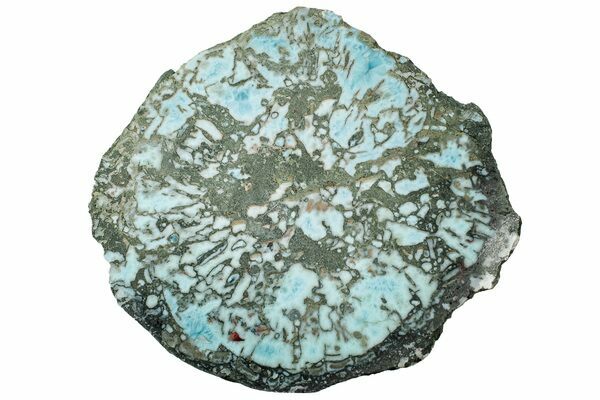
A slice of a Larimar replaced wood limb cast.
In rare cases, blue pectolite crystallized in place of the wood’s cellular structure. The result is larimar pseudomorphs after wood—specimens that preserve the texture, grain, and even growth rings of ancient trees, but in stunning shades of blue. These specimens are highly prized by collectors because they represent a convergence of two geological stories: paleontology and mineralogy. They capture the anatomy of prehistoric trees while simultaneously showcasing the volcanic hydrothermal processes that formed larimar itself.
Such pieces are uncommon and often display subtle structural detail rather than bold ocean-like patterns, making them especially interesting from a scientific standpoint.
Larimar is found in only one place on Earth: the southwestern Dominican Republic. Its exclusive home is in Barahona Province, within the rugged Bahoruco Mountain Range, where volcanic rocks host the gem-bearing deposits. The most important mining area is around Los Chupaderos, near the town of Paraíso, and also includes sites like the Las Filipinas mine where much of the material is extracted. Mining here is highly localized and small-scale, with narrow hand-dug tunnels piercing basalt flows to reach veins and pockets of blue pectolite. More than 700 miners are involved in extracting larimar from these workings, which often extend deep into steep mountainsides.
Because larimar occurs in such a specific geological setting, no deposits of comparable quality have been identified elsewhere in the world. While ordinary white and gray pectolite is widespread in places like Canada, the United States, and Europe, gem-quality blue larimar is unique to the Dominican Republic.
In terms of production volumes, larimar mining yields are still modest compared with major gemstone industries, but they have been rising in recent years thanks to increased international demand and better mining organization. Official export certificates issued by the Dominican Ministry of Energy and Mines show that in 2024 the country exported more than 55,000 pounds (≈25 000 kg) of larimar, and in 2025 exports have more than doubled, surpassing 230,000 pounds (≈105 000 kg) of the stone. These figures include both rough and worked material destined for markets such as China, the United States, India, Germany, England, and Italy.
Although locals reportedly noticed blue stones washing up along beaches as early as 1916, larimar remained largely unknown outside the Dominican Republic for decades. Its official rediscovery came in 1974, when Dominican Miguel Méndez and Peace Corps volunteer Norman Rilling followed pieces of blue stone found along the Bahoruco River upstream into the mountains. There, within volcanic rock in the Sierra de Bahoruco, they located the source of the striking blue material.
Méndez coined the name “Larimar” by combining “Larissa,” his daughter’s name, with “mar,” the Spanish word for sea—a fitting tribute to both family and the gem’s ocean-like colors. Once identified as a blue variety of pectolite, interest in the stone began to grow, and small-scale mining operations gradually expanded in the Barahona region.
Because larimar ranks only 4.5 to 5 on the Mohs hardness scale, it is relatively soft compared to many popular gemstones. As a result, it is most commonly fashioned into pendants, earrings, beads, and cabochons rather than high-impact ring settings that might expose it to wear. Skilled lapidaries often cut it to emphasize its natural marbling, highlighting the swirling white patterns that resemble sunlight rippling across tropical waters.
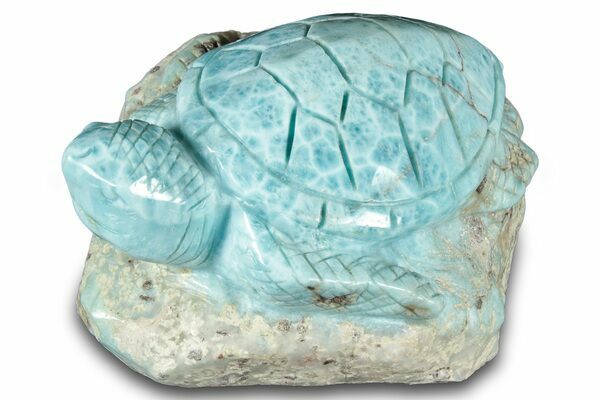
A carved Larimar sea turtle highlighting this stones connection to the Caribbean sea.
Today, larimar holds special cultural and economic significance within the Dominican Republic. It has been designated a national gemstone and plays a major role in the country’s gemstone jewelry industry. Internationally, it is often marketed as the “Caribbean Gem,” a name that reflects both its exclusive origin and its unmistakable coloration. In metaphysical circles, it is frequently associated with calmness, tranquility, and oceanic energy, reinforcing the visual impression that the stone carries a piece of the sea within it.
Beyond its use in jewelry, larimar is highly prized by mineral collectors because of its limited geographic occurrence and distinctive appearance. Fine specimens displaying intense blue color with dramatic white marbling command premium prices, especially when the patterning evokes waves, clouds, or coral reef shallows.
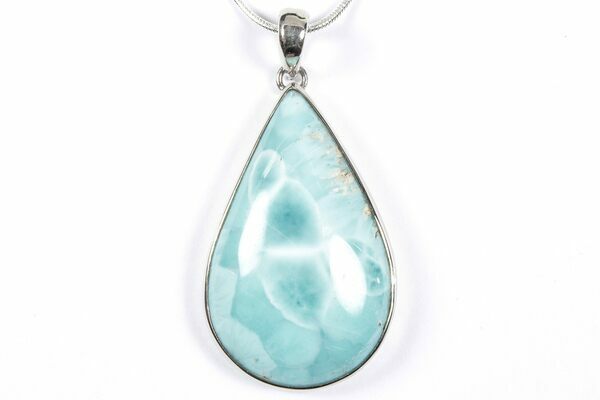
A beautiful Larimar pendant.
In just a few decades, larimar has evolved from a little-known river stone into one of the most geographically distinctive gemstones in the world. Its appeal is inseparable from its origin—volcanic, tropical, and singular. It remains, quite literally, a fragment of the Caribbean preserved in stone.

Larimar is the blue variety of the mineral pectolite, a mineral that is typically white or gray and found in many parts of the world. But in a remarkable geological twist, trace amounts of copper within the Dominican material transform ordinary pectolite into something extraordinary—coloring it in hues that range from pale sky blue to deep volcanic blue. The most prized pieces resemble swirling ocean currents, complete with cloud-like white patterns caused by fibrous crystal structures.
Unlike many famous gemstones, larimar is a relative newcomer to the world stage. It was only officially rediscovered in 1974, making it younger in commercial history than many of the jewelry pieces crafted from it. Yet locals had known of blue stones washing down rivers for decades before its formal identification. The stone’s name itself is deeply personal—combining “Larissa,” the daughter of its rediscoverer, with “mar,” the Spanish word for sea.
Larimar’s volcanic origins add another layer of intrigue. It forms within cavities of ancient basaltic lava flows, born from hydrothermal activity associated with Caribbean volcanism millions of years ago. In some cases, it even replaces fossilized wood—creating rare specimens where ancient tree structures are preserved in shades of tropical blue.
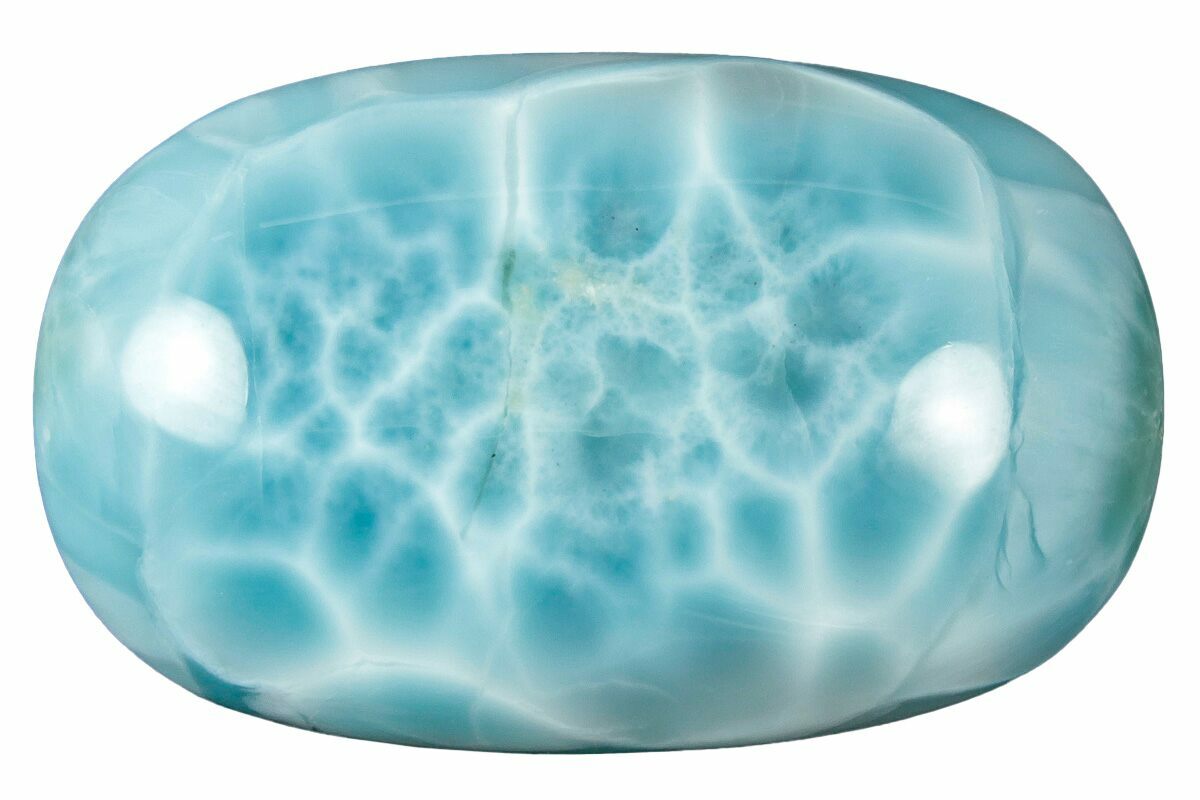
A polished Larimar cabochon displaying the color and patterning of gem-grade material.
Its rarity, singular origin, and unmistakable color have made larimar one of the most distinctive gemstones in the world. Often called the “Dolphin Stone,” the “Atlantis Stone,” or the “Caribbean Gem”, larimar carries with it a sense of place unlike almost any other mineral. It is not merely a stone—it is geology, history, and ocean all captured in crystal form.
Properties of Larimar
How Larimar Forms
Larimar’s formation is tied directly to volcanic activity in the Caribbean region. Millions of years ago, during the Miocene epoch, volcanic eruptions in what is now the southwestern Dominican Republic produced thick basaltic lava flows. As these lavas cooled, cavities and fractures developed within the rock.
Hydrothermal fluids—hot, mineral-rich waters—circulated through these volcanic rocks. These fluids carried dissolved elements including sodium, calcium, silica, and crucially, copper. Under the right temperature and pressure conditions, pectolite crystallized within these cavities.
Ordinary pectolite is typically white or gray. However, when copper substitutes into the crystal structure or influences the chemistry during growth, it imparts the distinctive blue coloration that defines larimar. The fibrous crystal structure grows in radiating patterns, creating the swirling, cloud-like appearance so characteristic of high-quality material. Because the conditions required are highly specific—particularly the presence of copper in the hydrothermal system—blue pectolite of gem quality formed in only this one small region.
Larimar as a Replacement of Petrified Wood
One of the most fascinating and lesser-known occurrences of larimar is its role in replacing fossilized wood. In certain areas of the Dominican Republic, hydrothermal fluids not only filled cavities in basalt but also permeated buried wood within volcanic deposits. Over time, the original organic material decayed and was gradually replaced molecule by molecule with mineral-rich solutions.
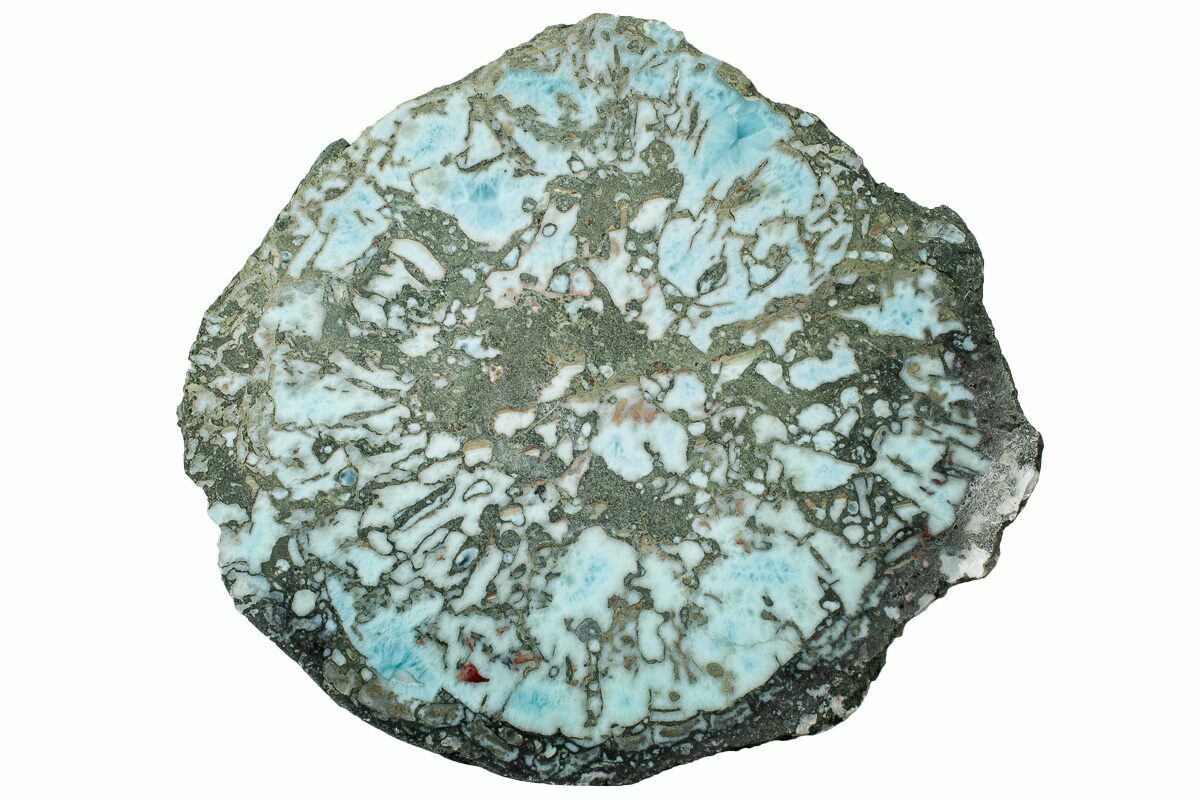
A slice of a Larimar replaced wood limb cast.
In rare cases, blue pectolite crystallized in place of the wood’s cellular structure. The result is larimar pseudomorphs after wood—specimens that preserve the texture, grain, and even growth rings of ancient trees, but in stunning shades of blue. These specimens are highly prized by collectors because they represent a convergence of two geological stories: paleontology and mineralogy. They capture the anatomy of prehistoric trees while simultaneously showcasing the volcanic hydrothermal processes that formed larimar itself.
Such pieces are uncommon and often display subtle structural detail rather than bold ocean-like patterns, making them especially interesting from a scientific standpoint.
Collecting Localities
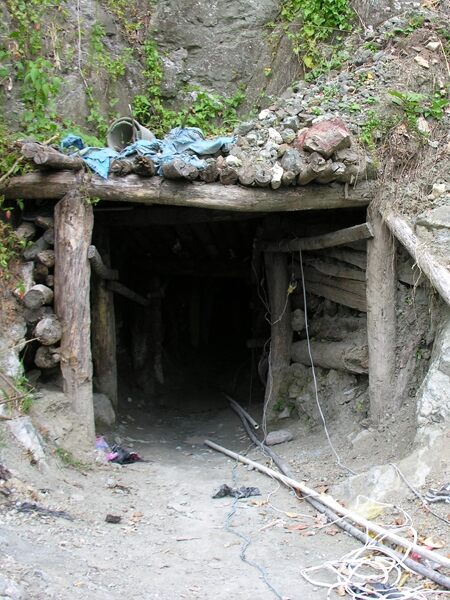
Larimar is found in only one place on Earth: the southwestern Dominican Republic. Its exclusive home is in Barahona Province, within the rugged Bahoruco Mountain Range, where volcanic rocks host the gem-bearing deposits. The most important mining area is around Los Chupaderos, near the town of Paraíso, and also includes sites like the Las Filipinas mine where much of the material is extracted. Mining here is highly localized and small-scale, with narrow hand-dug tunnels piercing basalt flows to reach veins and pockets of blue pectolite. More than 700 miners are involved in extracting larimar from these workings, which often extend deep into steep mountainsides.
Because larimar occurs in such a specific geological setting, no deposits of comparable quality have been identified elsewhere in the world. While ordinary white and gray pectolite is widespread in places like Canada, the United States, and Europe, gem-quality blue larimar is unique to the Dominican Republic.
In terms of production volumes, larimar mining yields are still modest compared with major gemstone industries, but they have been rising in recent years thanks to increased international demand and better mining organization. Official export certificates issued by the Dominican Ministry of Energy and Mines show that in 2024 the country exported more than 55,000 pounds (≈25 000 kg) of larimar, and in 2025 exports have more than doubled, surpassing 230,000 pounds (≈105 000 kg) of the stone. These figures include both rough and worked material destined for markets such as China, the United States, India, Germany, England, and Italy.
History & Uses
Although locals reportedly noticed blue stones washing up along beaches as early as 1916, larimar remained largely unknown outside the Dominican Republic for decades. Its official rediscovery came in 1974, when Dominican Miguel Méndez and Peace Corps volunteer Norman Rilling followed pieces of blue stone found along the Bahoruco River upstream into the mountains. There, within volcanic rock in the Sierra de Bahoruco, they located the source of the striking blue material.
Méndez coined the name “Larimar” by combining “Larissa,” his daughter’s name, with “mar,” the Spanish word for sea—a fitting tribute to both family and the gem’s ocean-like colors. Once identified as a blue variety of pectolite, interest in the stone began to grow, and small-scale mining operations gradually expanded in the Barahona region.
Because larimar ranks only 4.5 to 5 on the Mohs hardness scale, it is relatively soft compared to many popular gemstones. As a result, it is most commonly fashioned into pendants, earrings, beads, and cabochons rather than high-impact ring settings that might expose it to wear. Skilled lapidaries often cut it to emphasize its natural marbling, highlighting the swirling white patterns that resemble sunlight rippling across tropical waters.
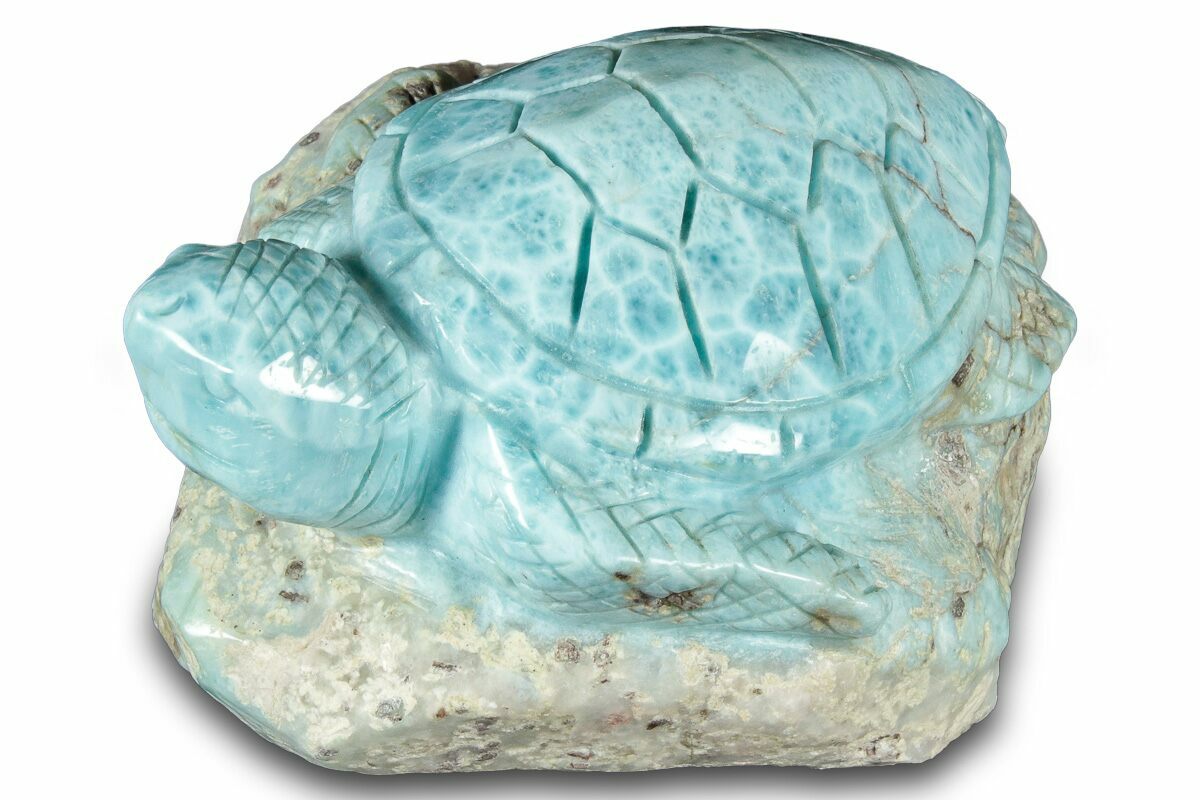
A carved Larimar sea turtle highlighting this stones connection to the Caribbean sea.
Today, larimar holds special cultural and economic significance within the Dominican Republic. It has been designated a national gemstone and plays a major role in the country’s gemstone jewelry industry. Internationally, it is often marketed as the “Caribbean Gem,” a name that reflects both its exclusive origin and its unmistakable coloration. In metaphysical circles, it is frequently associated with calmness, tranquility, and oceanic energy, reinforcing the visual impression that the stone carries a piece of the sea within it.
Beyond its use in jewelry, larimar is highly prized by mineral collectors because of its limited geographic occurrence and distinctive appearance. Fine specimens displaying intense blue color with dramatic white marbling command premium prices, especially when the patterning evokes waves, clouds, or coral reef shallows.
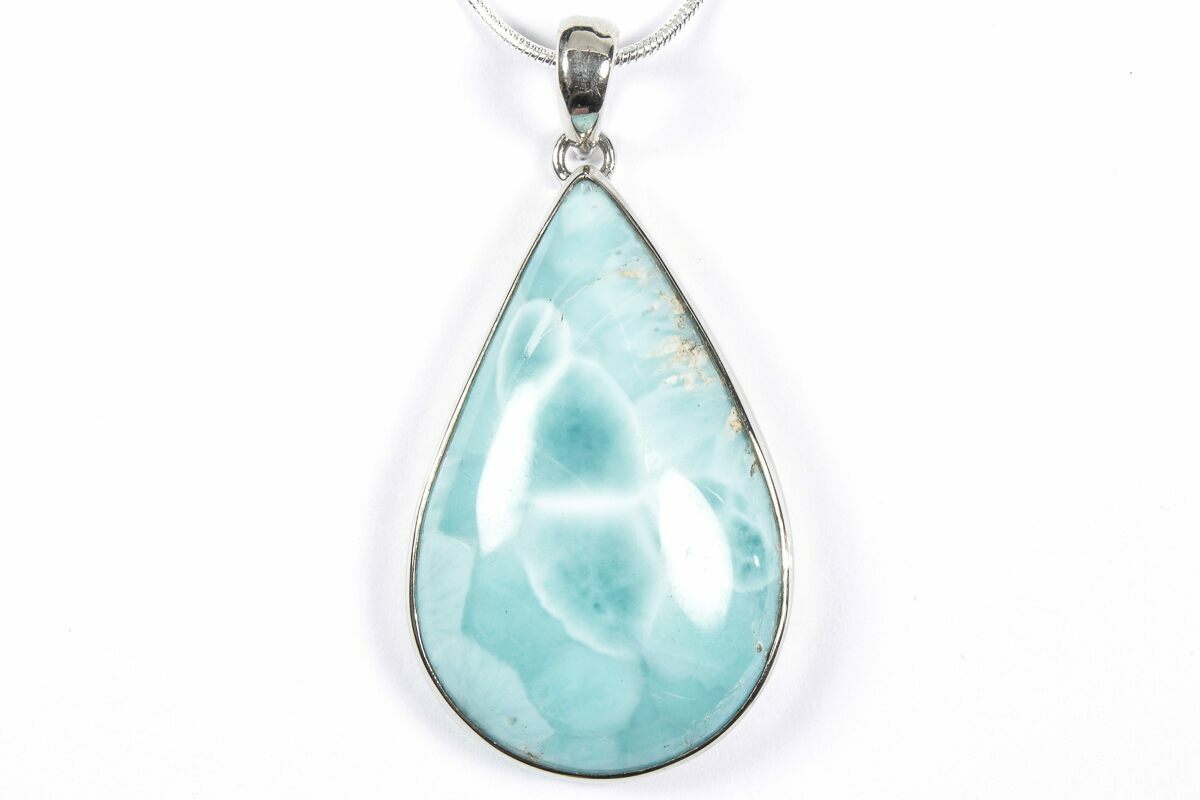
A beautiful Larimar pendant.
In just a few decades, larimar has evolved from a little-known river stone into one of the most geographically distinctive gemstones in the world. Its appeal is inseparable from its origin—volcanic, tropical, and singular. It remains, quite literally, a fragment of the Caribbean preserved in stone.


